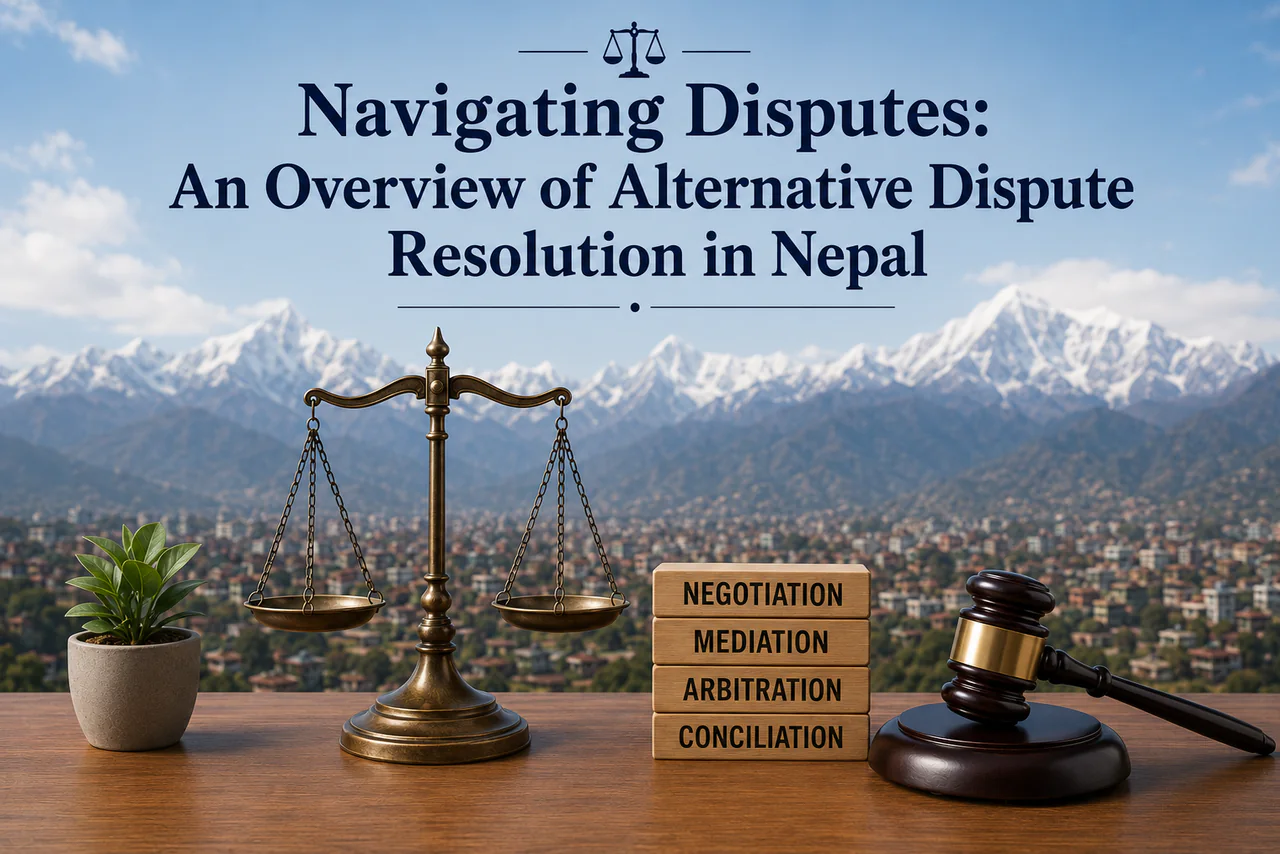
Navigating Disputes: An Overview of Alternative Dispute Resolution in Nepal

Introduction to the concept of Alternative Dispute Resolution (ADR):

Alternative Dispute Resolution (ADR) comprises a range of processes and set of practice designed to resolve conflicts outside the traditional courtroom setting. Embracing methods such as mediation, arbitration, and conciliation, ADR offers a more flexible, efficient, and cost-effective means of settling disputes. By focusing on collaborative approaches, ADR not only alleviates the burden on judicial systems but also fosters amicable solutions that preserve relationships and promote mutual understanding.

Evolution and adoption of ADR practices in Nepal:

Alternative dispute resolution (ADR) has a rich history, its origins lie in the traditional practices of local communities, where village elders would mediate disputes by consulting with the involved parties. Over time, however, ADR methods have gained significant popularity in Nepal, evolving into a preferred approach for resolving conflicts. In Nepal, the integration of ADR mechanisms is gradually transforming the landscape of dispute resolution, providing individuals and businesses with accessible and equitable pathways to justice, which has led to an increase in their popularity. ADR is the favored method of resolving disputes in Nepal, largely because of its deep-rooted presence in the nation’s culture and history, as well as its ability to foster and maintain relationships.

The Significance of ADR in the Modern Legal Landscape:

In the contemporary legal realm, Alternative Dispute Resolution (ADR) stands as a beacon of innovation and efficiency. As traditional litigation struggles with escalating costs, prolonged timelines, and procedural rigidity, ADR emerges as a dynamic alternative, reshaping the way justice is perceived and administered. Alternative dispute resolution methods offer numerous advantages. They tend to be faster and more economical compared to traditional litigation. While court cases can extend over several years, ADR can settle disputes within months or even weeks, significantly saving time and money for those involved. ADR’s relevance extends beyond mere convenience; it embodies a paradigm shift towards more collaborative and less adversarial forms of conflict resolution. By fostering dialogue and mutual understanding, ADR not only alleviates the burden on overtaxed judicial systems but also preserves the relational fabric of society. This is particularly beneficial for ongoing business interactions.

Lastly, ADR provides greater flexibility in reaching a resolution. Unlike litigation, where a judge’s decision is final and binding, ADR allows parties to have more control over the outcome, enabling them to devise innovative solutions that satisfy all involved. It provides a platform where disputes can be resolved with a sense of fairness and equity, often yielding outcomes that are both practical and sustainable. In Nepal, the growing integration of ADR mechanisms underscores its pivotal role in democratizing access to justice. By bridging the gap between traditional legal processes and the evolving demands of modern society, ADR shows the ongoing effort to create a fairer and more accessible legal system.

ADR Mechanisms in Nepal:

Negotiation:

Negotiation includes direct discussion between the parties involved in a dispute, aiming to reach a mutually acceptable solution without the intervention of a third party. Negotiation is often the first step before resorting to more formal ADR methods.

Mediation:

This process involves a neutral third party, known as the mediator, who facilitates discussions between disputing parties to help them reach a mutually acceptable agreement. If the agreement includes a clause for appointing a mediator, the appointment will follow the terms specified in that clause. If no such provision exists, the mediator will be appointed in accordance with the Mediation Act, 2068. Mediation in Nepal is often used for family disputes, commercial conflicts, and civil matters, aiming to promote amicable resolutions and maintain relationships.

Arbitration:

In arbitration, the parties involved agree to submit their dispute to an arbitrator or a panel of arbitrators whose decision is typically binding. This mechanism is commonly utilized for commercial and contractual disputes, offering a more formalized yet flexible approach compared to court litigation. Arbitration proceedings in Nepal are governed by the Arbitration Act, 2055 (1998), which aligns with international standards to ensure fairness and efficiency.

Conciliation:

Similar to mediation, conciliation involves a neutral conciliator who helps the parties in dispute reach an agreement. However, the conciliator may play a more active role in proposing solutions and offering recommendations. Conciliation is used in various contexts, including labor disputes and family matters, to facilitate resolution through cooperative dialogue.

Legal framework of ADR in Nepal:

The formalization of ADR practices in Nepal began with the Arbitration Act of 1981, which was later replaced by the Arbitration Act of 1999(2055). This legislative framework is further supported by various other laws and the ratification of the New York Convention of 1958 in 1998. To support and enhance ADR practices, Nepal has enacted and revised many domestic laws including the Contract Act, the Company Act, Labor Act, Securities Act, Banking Laws, Investment and Technology Transfer Act.

In 2003, the Supreme Court of Nepal incorporated court-referred mediation into the District Court Rules, 1995 (2052 B.S.) through a fourth amendment. Additionally, in 2004, the Full Court of the Supreme Court established the Operational Guidelines for Mediation. Following three years of mediation practices, the Supreme Court extended mediation to the Appellate Court and the Supreme Court itself in 2006 by amending court rules. Furthermore, in 2011, prompted by the Supreme Court, the Legislature-Parliament enacted the Mediation Act, 2068 as a comprehensive framework, establishing a high-level Mediation Council to advance and oversee the mediation process.

Institution and Authorities overseeing ADR:

In Nepal, several institutions and authorities play crucial roles in overseeing and implementing Alternative Dispute Resolution (ADR) mechanisms.

Mediation Council:

Established under the Mediation Act 2068, the Mediation Council serves as the apex body responsible for overseeing the mediation process in Nepal. The Council’s functions include setting standards for mediators, providing training, and ensuring the effective implementation of mediation practices. It also monitors mediation proceedings and ensures compliance with established guidelines.

Nepal Council of Arbitration (NEPCA):

Nepal Council of Arbitration “NEPCA” is an autonomous body and non-profitable organization which is established to administer arbitration proceedings in Nepal. It oversees the conduct of arbitration, appoints arbitrators, and ensures that arbitration awards are issued and enforced in accordance with the Arbitration Act. The Tribunal ensures that arbitration is conducted fairly and efficiently. It also deals with other alternative methods of dispute resolution in an expeditious and less expensive manner.

Supreme Court/ District and Appellate Courts:

These courts facilitate the implementation of ADR processes at various levels of the judiciary. Most importantly, the Supreme Court is instrumental in integrating ADR within the judiciary and promoting its use. It has established court-referred mediation practices, provided guidelines for mediation, and extended these practices to the Appellate and District Courts. District and Appellate Courts are also involved in monitoring the effectiveness of ADR methods in resolving disputes. They refer cases to mediation and arbitration, provide support for ADR proceedings, and ensure that ADR practices are integrated into the judicial process.

The growing acceptance and implementation of ADR in Nepal reflect a significant shift towards a more collaborative and efficient legal system. By integrating ADR mechanisms, Nepal is not only alleviating the burden on its courts but also promoting a culture of dialogue and mutual understanding. The support of key institutions, such as the Mediation Council, the Supreme Court, and various legal aid committees, ensures that ADR practices are standardized, accessible, and effective. As Nepal continues to develop its legal framework and promote the use of ADR, the country stands to benefit from more harmonious and equitable dispute resolution processes. Embracing these alternative methods marks a progressive step towards a more just and fair society, where conflicts are resolved with dignity and efficiency.

Disclaimer

DisclaimerS & S Jurists, a boutique law firm specializing in Taxation and Corporate matters, publishes articles on its website for information purposes for its clients. It shall not be taken as legal advice, advertisement, personal communication, solicitation or inducement. The firm and its team members shall not be liable for the consequence arising of the information provided here. In case, if you need further legal advice on the subject matter, please contact us.

Contact us for any legal query

Our Mission is to provide timely delivery of service in an efficient manner, exceeding client’s expectations. If you have any complaints, suggestions or feedback; please feel free to reach out to us!

0 Comments

0 Comments

Related Articles

An Overview of Appellate Remedy of Taxation in Nepal

We are not final because we are infallible, but we are infallible only because we are final. Justices of this Court are human beings, capable of erring.Justice Robert H. Jackson Appeal: The Rationale Behind it The aforesaid quotation was borrowed from the famous...

read more

Corporate Social Responsibility in Nepal

Corporate Social Responsibility Corporate Social Responsibility (CSR) is a self-regulating business model that helps a company be socially accountable to itself, its stakeholders, and the public. It means that companies conduct their operations in ways that positively...

read more

Consumer Protection Framework and Market Regulation in Nepal

A consumer is legally defined as a person who purchases or uses goods or services primarily for personal use rather than for resale or business purposes. The Consumer Protection Act of Nepal defines consumer as a person or institution that consumes or uses any goods...

read more

How to Convert a Public Company into a Listed Company in Nepal

If your company is already incorporated under the Companies Act as a public company that gives you a head start you do not need to convert from private to public. But listing on the Nepal Stock Exchange (NEPSE) via a public issuance is still a multiphase, regulated...

read more

Industrial Enterprises Act, 2076 (2020)

1. Introduction Industrial Enterprises Act, 2076 (2020) was introduced by repealing the Industrial Enterprises Act, 2016 (the “Previous Act”). The Act is a principal legislation for registration, establishment and pre/post operational compliances of industry. No...

read more

Grievance Redressal and Offences under the E-Commerce Act, 2081

The E-Commerce Act, 2081 (2025) in Nepal establishes a comprehensive legal framework regulating electronic commerce. Two of the most significant aspects of the Act are: The Grievance Redressal Mechanism, which safeguards consumers’ rights and provides a structured...

read more

Nepal Government Issues New Minimum Wage Rates Effective FY 2082

Kathmandu, July 21, 2025 – The Ministry of Labor, Employment and Social Security has formally announced an updated structure of minimum wages for workers across Nepal, with effect from July 17, 2025 (1 Shrawan 2082). The notice, issued in the Nepal Gazette, derives...

read more