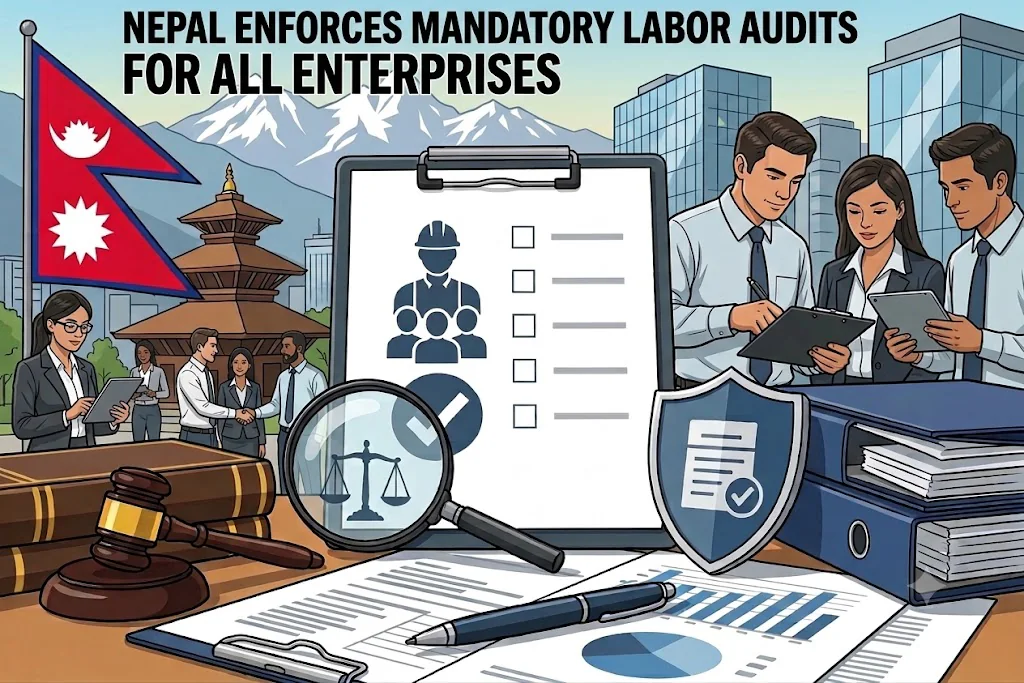
The Government of Nepal has formally enforced a new compliance requirement mandating all registered enterprises to conduct an annual labor audit in accordance with the Labor Act, 2074 (2017) and the Labor Rules, 2075 (2018). This legal reform aims to ensure accountability in labor practices, promote ethical employment standards, and align Nepal’s domestic framework with international labor norms.
Legal Foundation and Compliance Requirement
Under Section 100 of the Labor Act, 2074 and Rule 56 of the Labor Rules, 2075, every enterprise regardless of size or sector must complete a labor audit by the end of Poush (mid-January) each fiscal year. The audit report must then be submitted to the respective Labor and Employment Office within the prescribed period.
The audit is designed to assess whether the enterprise is fully complying with statutory obligations, including:
- Timely payment of wages and adherence to minimum wage standards;
- Maintenance of proper working hours and overtime regulations;
- Provision of leave and benefits as mandated by law;
- Ensuring occupational health, safety, and welfare measures;
- Proper registration and contribution to the Social Security Fund; and
- Compliance with collective bargaining, trade union rights, and other labour-related statutes.
Who Can Conduct the Audit
Enterprises may either appoint an internal auditor (a managerial-level employee with relevant qualifications) or engage an external labor auditor.
External auditors must meet specific criteria Nepali citizenship, at least a Bachelor’s degree, and two years of managerial or industrial experience ensuring professional accountability in the audit process.
Penalties for Non-Compliance
Failure to submit a labor audit report, or submitting a false or misleading one, can result in fines of up to NPR 20,000 as per Section 163(2)(b) of the Act.
Beyond monetary penalties, enterprises risk being flagged for inspection, which may lead to administrative sanctions or temporary suspension of operations in serious cases of labor law violation. <!– Gutenberg Image Block –> <!– Insert Image from Page 2: Calculator, pen, and financial chart –> <!– Place before the next heading –>
Purpose and Broader Impact
According to officials at the Ministry of Labor, Employment, and Social Security, the new rule is part of a larger effort to institutionalize compliance, protect workers’ rights, and bring transparency to Nepal’s employment ecosystem.
The government expects that regular audits will:
- Help identify and correct non-compliance early;
- Prevent exploitative practices such as wage withholding or unsafe work environments;
- Foster better employer–employee relations through accountability; and
- Strengthen Nepal’s standing in international labor forums, particularly as the country pursues trade agreements and foreign investment opportunities that prioritize ethical business conduct.
Challenges and the Way Forward
While the framework is legally sound, effective implementation remains a challenge. Many small and medium enterprises (SMEs) still lack awareness of the new requirement or the technical expertise to conduct such audits. Similarly, the capacity of local labor offices to review and enforce audit reports will be crucial in determining the success of this initiative.
Legal experts note that beyond mere formality, the audit process must be substantive focusing not only on paperwork but also on actual workplace conditions and compliance behavior.
Conclusion
From a legal standpoint, the compulsory labor audit represents a progressive step in Nepal’s labor governance. It bridges the gap between law and practice by introducing a structured compliance mechanism. For enterprises, this marks a transition from reactive compliance (responding to complaints or inspections) to proactive governance, where compliance becomes part of corporate culture.