The Electronic Commerce (E-Commerce) Act, 2081 establishes Nepal’s first comprehensive legal framework for regulating online commercial activities. It aims to ensure transparency, consumer protection, and accountability in the rapidly growing digital marketplace.
This Act provides detailed procedures for registration, payment, consumer rights, data protection, and defines the roles and obligations of all participants in electronic transactions.
Below is an explanation of the Act’s major features and implications.
Nationwide and Extraterritorial Jurisdiction
(Section 1)
The Act applies throughout Nepal and also extends to foreign businesses that supply goods or services electronically to customers located in Nepal.
This ensures that all online commercial activities targeting Nepali consumers regardless of the seller’s physical location fall under the Act’s jurisdiction, promoting uniform regulatory coverage.
Mandatory Registration and Platform Establishment
(Sections 4 & 5)
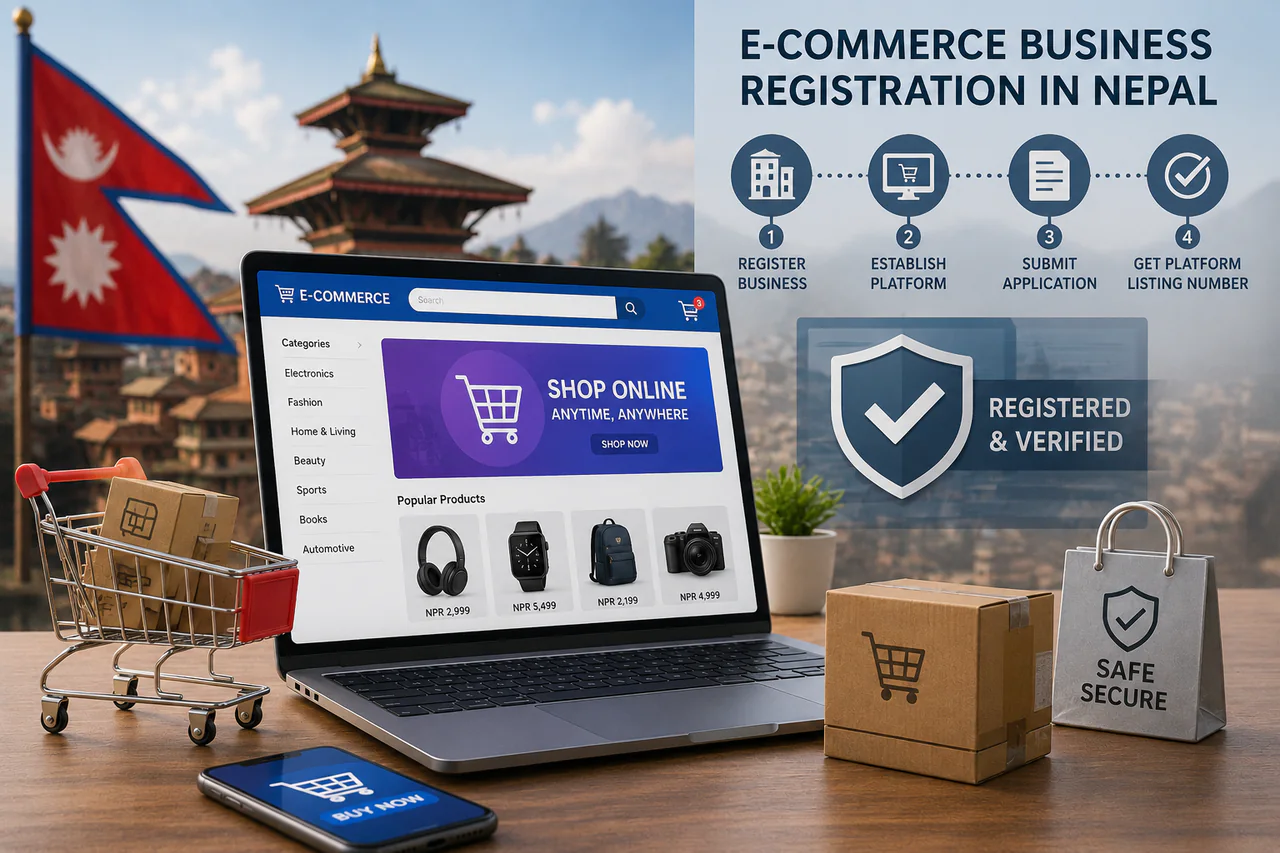
Every entity engaged in e-commerce must create and operate its own electronic platform such as a website, mobile app, or any other digital system for carrying out business transactions.
Each platform must publicly disclose:
- The platform’s name
- The business entity’s name and registration details
- Office location(s)
- Any licenses or approvals required to operate
- The nature of the business (direct seller or intermediary)
- Tax registration numbers
- Contact information and complaint-handling channels
If any business information changes, updates must be reflected on the platform within 48 hours.
However, micro and small-scale entrepreneurs are exempt from this requirement. They can operate through existing third-party e-commerce platforms without establishing their own. The definitions of “micro” and “cottage” enterprises follow the Industrial Enterprises Act, 2020.
Definitions and Key Participants in E-Commerce
The Act clearly defines the different parties involved in e-commerce transactions and specifies their roles and responsibilities:
Consumer
Any individual who purchases or uses goods or services for personal consumption.
Buyer
A person who purchases goods or services, including authorized representatives acting on their behalf.
Seller
An individual or business entity offering goods or services for sale through an electronic platform.
Intermediary Business
A business that facilitates transactions between sellers and buyers through electronic systems.
Business
Includes both intermediary businesses and list-based e-commerce operators.
List-Based E-Commerce Business
A person or entity that lists goods or services and sells them directly through their own online platform.
Transparency and Consumer Protection
The Act prioritizes consumer trust and fair trade in online transactions. It requires every e-commerce platform to provide accurate and complete details about goods and services, including:
- Product descriptions and specifications
- Prices inclusive of all applicable taxes
- Delivery schedules and timelines
- Warranty or guarantee terms
- Return and refund policies
Buyers must receive invoices or receipts promptly after making payments.
All platforms are required to maintain accessible and efficient grievance redressal systems to resolve consumer complaints.
Legal Validity of Electronic Contracts
(Section 7)
Contracts executed electronically are legally enforceable and carry the same validity as traditional paper-based agreements.
A contract under this Act refers to an electronic agreement between a buyer and a seller regarding the sale or supply of goods or services.
The applicable law will be the law governing the contract, and if any inconsistency arises with other laws, the provisions of the e-commerce contract will prevail.
Sellers are required to provide buyers with all necessary contract information, including:
- Terms and conditions related to purchase and delivery
- Cancellation, refund, return, and warranty provisions
- Refund and reimbursement procedures
- Any other legal or regulatory information applicable to the transaction
Payment and Transaction Procedures
(Section 8)
The Act outlines the legal structure for digital payments in e-commerce transactions. It allows payments to be made to the business entity directly or to a delivery service provider acting on behalf of the business. Payments may occur before, during, or after the purchase or transfer of goods or services.
Key provisions include:
- Payments must be made using legally prescribed instruments or electronic payment systems authorized by prevailing financial laws.
- Payments made to a delivery service provider are considered equivalent to payments made directly to the business.
- All payments must comply with federal payment and settlement laws.
- Upon receiving payment, the seller must promptly issue a valid electronic or physical receipt acknowledging the transaction.
- Any transaction involving foreign currency must follow Nepal’s foreign exchange regulations.
When payments are made properly, they are considered valid and complete under the law.
Inclusion of Social Media Sellers
The Act explicitly includes sellers operating through social media platforms such as Facebook, Instagram, or TikTok within its regulatory framework.
These sellers must register and comply with all applicable requirements under the Act, ensuring consumer protection across all online sales channels.
Delivery, Return, and Refund Obligations
Transfer of Goods and Services
(Section 9)
Sellers must deliver goods or services at the agreed location and time specified in the contract.
The buyer or an authorized representative must be physically present to receive the delivery when required.
Delivery from the seller’s sales center is considered valid if it fulfills the agreed terms.
Once goods or services are delivered, the delivery is deemed complete.
Buyers may demand delivery receipts, and any change in delivery terms must be mutually agreed upon by both parties.
Warranty of Goods and Services
(Section 10)
If goods or services lack the required warranty description, buyers may return them unused and demand a full refund.
Sellers must accept returns and process refunds without imposing unreasonable conditions.
Buyers may also request replacement for defective goods of the same type and value.
If a buyer refuses a replacement, the seller must refund the paid amount including applicable taxes within the agreed timeframe.
Warranty-related matters will be governed by prevailing consumer protection laws.
Counterfeit and Smuggling
(Section 11)
Smuggling or illegal import of goods sold electronically is strictly prohibited.
Goods imported from foreign sellers using unauthorized payment systems will be treated as counterfeit, and legal penalties will apply under relevant laws.
Data Protection and Privacy
(Section 12)
E-commerce operators must safeguard customer data and prevent any unauthorized use or disclosure.
Personal or identifiable information collected during online transactions must remain confidential, except where disclosure is required by law.
Information exchange between buyers and sellers to complete a transaction (e.g., delivery coordination) is permitted.
Sellers are prohibited from using customer data for unauthorized or unrelated purposes.
Violations result in penalties under prevailing data protection laws.
Prohibition on Distribution and Sale Without Authorization
(Section 13)
If the sale or distribution of certain goods or services requires a license or special permit, sellers must obtain these before operating online.
Selling or distributing such goods without proper authorization leads to legal action under the applicable laws.
Responsibilities of the Parties Involved
A. Responsibilities of Intermediary Sellers
(Section 14)
- Sell only goods or services accurately listed on the platform.
- Comply with tax obligations under prevailing laws.
- Fulfill all warranty and guarantee commitments.
- Maintain fair competition among sellers and avoid discrimination.
- Enter into formal agreements with all sellers listed on the platform.
- Provide refunds and compensation when buyers return goods or demand refunds under the law.
B. Responsibilities of List-Based E-Commerce Businesses
(Section 15)
- Clearly list goods or services with accurate information.
- Publish all legally required data and disclosures.
- Avoid false consumer identities or fake reviews and ratings.
- Refrain from misleading advertisements.
- Follow all tax laws and honor warranty or refund obligations.
- Deliver products at or below the agreed price, except in exceptional cases.
- Address any issues related to intellectual property fairly and transparently.
C. Responsibilities of Sellers
(Section 16)
- Operate only through intermediary platforms with written or electronic contracts.
- Provide all necessary registration, tax, and business documents.
- Deliver goods or services within the agreed time and price.
- Avoid unfair business practices or misrepresentation.
- Maintain transparency in product listings and refrain from fake reviews.
- In case of defective, delayed, or expired goods, sellers must refund or replace them promptly.
- Sellers must not engage in unauthorized commercial activities under any circumstances.
D. Responsibilities of Buyers
(Section 17)
- Comply with all terms of the digital contract made with the seller.
- Avoid fraudulent or malicious actions that harm the integrity of e-commerce.
- Have the right to verify goods and report defects through digital means promptly.
E. Responsibilities Related to Delivery
(Section 18)
- Sellers must provide delivery as per contract terms.
- Delivery agents must have separate agreements with sellers.
- Consumer protection laws apply fully to delivery operations.
- Violations during delivery are punishable under consumer protection laws.
Prohibition of Unfair Commercial Activities
(Section 19)
No buyer, seller, or intermediary may engage in unfair, deceptive, or exploitative business activities.
Violations attract penalties under this Act and other applicable laws.
Compliance Monitoring and Enforcement
The Department of Commerce, Supplies, and Consumer Protection is the primary enforcement authority responsible for registration, audits, and legal actions.
Penalties include:
- NPR 20,000 to 100,000 for false advertising, nondisclosure, or unfair practices.
- Additional penalties for delivery failures under the Consumer Protection Act.
- Up to 3 years imprisonment or fines up to NPR 500,000 for severe violations.
- Prosecutions are handled by Consumer Courts or government-designated tribunals.
State Case and Summary Procedure
(Sections 23 & 24)
Offenses under this Act are treated as state cases and are adjudicated through summary procedures, ensuring efficient and timely legal resolution. The consumer court is the trial court for the issues under this act.
Right to File Complaints
(Section 28)
Any individual with knowledge or evidence of violations may file a complaint to the Director General or authorized officers.
Complaints can be submitted:
- Electronically or in writing
- With supporting evidence
- With a request for confidentiality if desired
Monitoring reports identifying violations are also treated as valid complaints.
Support for Micro and Cottage Industries
The Act supports micro and cottage enterprises by allowing them to operate via third-party e-commerce platforms rather than developing their own.
This approach encourages digital inclusion and ensures smaller businesses can access online markets easily.
Coordination with Related Laws
(Section 31)
The E-Commerce Act works in harmony with other relevant laws such as:
- The Companies Act
- The Consumer Protection Act
- The Value Added Tax (VAT) Act
Other consumer-related matters such as labeling, pricing, returns, inspections, dispute resolution, and compensation continue to be governed by these existing consumer protection laws, adjusted as needed for digital trade.
Grievance Redressal Mechanism
(Section 33)
Consumers dissatisfied with purchased goods or services can file complaints:
- In person
- Electronically
- Or through written notice
Upon receiving a complaint, businesses must:
- Register it immediately
- Inform the buyer or consumer promptly
- Investigate and take necessary action
This ensures prompt and transparent resolution of consumer issues.
Vicarious Liability
(Section 34)
Any electronic transaction performed by an employee, worker, or representative on behalf of a business is legally considered an act of the businessperson themselves.
This provision ensures that businesses remain fully responsible for the actions of their representatives.
Conclusion
The E-Commerce Act, 2081 represents a landmark step in strengthening Nepal’s digital economy.
It sets clear obligations for businesses, sellers, intermediaries, and consumers ensuring that online trade is transparent, fair, and secure.
From registration and payment systems to data privacy, warranties, and consumer redressal, the Act provides a complete legal structure to regulate and promote trustworthy e-commerce practices in Nepal.
For personalized legal advice or assistance in ensuring compliance with the E-Commerce Act, 2081, you can consult our firm. We’re here to help your business thrive safely and lawfully in Nepal’s growing digital marketplace.