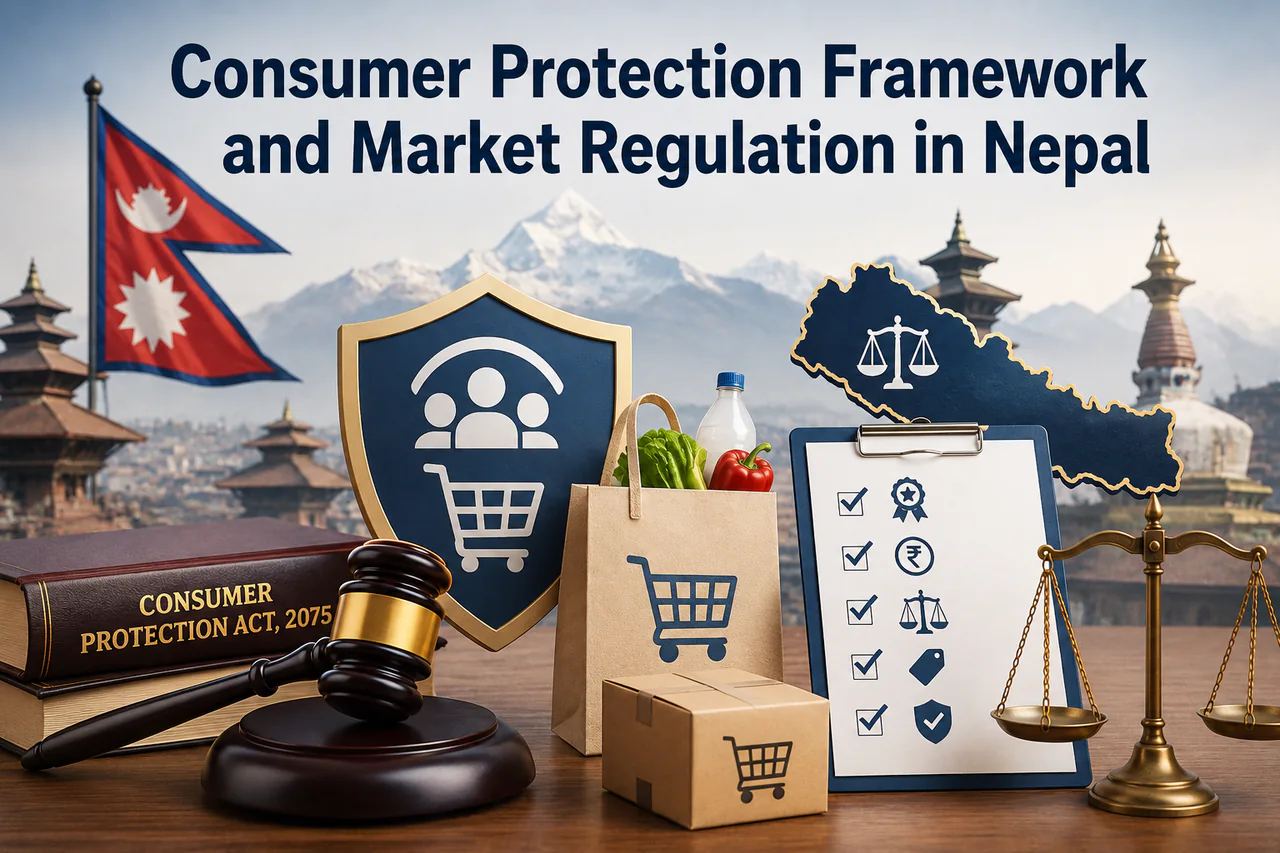
A consumer is legally defined as a person who purchases or uses goods or services primarily for personal use rather than for resale or business purposes. The Consumer Protection Act of Nepal defines consumer as a person or institution that consumes or uses any goods or services.
Laws Governing Consumer Rights and Market Regulation in Nepal
- Constitution of Nepal
- Consumer Protection Act, 2075
- Consumer Protection Regulation, 2076
Rights of Consumers in Nepal
The right of consumers is recognized as a fundamental right in Nepal. Article 44 of the Constitution of Nepal ensures the following:
- Every consumer is entitled to receive goods and services of good quality.
- Any person who suffers harm due to the use of substandard goods or services has the legal right to claim compensation under the law.
Rights of Consumer as per Consumer Protection Act
Section 3 of the Act stated the following Rights of the Consumers.
- Right to Quality Goods and Services
- Right of Easy Access to goods and services
- Right to Choose Fairly Priced Goods/Services
- Right to Information on Price, Purity, Quantity, Quality
- Right to Detailed Substance Information
- Right to Safety from Harmful Goods/Services
- Right to Legal Action Against Unfair Practices
- Right to Compensation for Harm/Injury
- Right to Remedy or Hearing
- Right to Consumer Education
Who regulates the supply, price, quality, measurement, labeling, and advertisement of goods and services to protect consumer rights?
As per section 4 of Consumer protection Act, 2074 the government of Nepal regulates the supply, price, quality, measurement, labeling, and advertisement of goods and services to protect consumer rights. Specifically, the Ministry of Industry, Commerce and Supply of the Government of Nepal is responsible of the regulation.
The ministry performs the following function to regulate supply, price, quality, measurement, labeling, and advertisement of goods and services to protect consumer rights:
- Implements policies on quality, price, and supply systems.
- Prevents monopoly and unfair trade practices harming consumers.
- Maintains a fair market by analyzing demand and supply.
- Controls undesired price increases by producers or sellers.
- Facilitates fair price supply through government-owned or associated institutions.
- Fixes maximum storage quantities in special situations.
- Buys food at prescribed prices and sells to the public during shortages.
- Ensures price uniformity via wholesale and retail management.
- Coordinates agencies to prevent artificial shortages and ensure distribution.
- Controls sale, distribution, and prevents black marketing and unfair business activities.
Labeling Requirements
As per section 5 of the Consumer Protection Act the producer must affix labels on goods.
The labels must include the following:
- Producer’s name, address, and registration number
- Ingredients and quantity for food, medicines, cosmetics
- Quality details if determined
- Usage instructions and possible side effects
- Expiry or use-before date if applicable
- Retail price, batch number, manufacturing date
- Warranty/guarantee info for electronics, machinery
- Reimbursement or repair provisions for defects
- Safety precautions for inflammable or hazardous goods
- Maximum retail price including taxes
- Required pre-use processes and related risks
- Awareness messages for harmful materials
- Other prescribed information
All the Labels must be in Nepali or English, understandable to the public. Any Goods without proper labels cannot be imported, sold, or distributed.
Exception to labeling: openly sold vegetables/fruits or goods shall not be labeled. But imported ones must be labeled. <!– Gutenberg Image Block –> <!– Insert image: Example of a Labeled Product –>
Liabilities of Parties Involved in Marketing of Goods and Services
Parties Involved
- Producer
- Importer
- Carrier
- Hoarder
- Seller
- Service Provider
Liability of Producer
- Quality Assurance
- Labeling Duties
- Recall Responsibility
- Consumer Compensation
- Advertising Standards
- Disclosure Requirement
- Legal Compliance
Liability for Harm
The producer is responsible for harm or injury caused by faults or defects in production, design, packaging, labeling, or distribution.
Importer’s Liabilities
- Price Compliance
- Information Duty
- Legal Compliance
- Additional Liabilities
Restrictions on Import
Goods that cannot be used or will expire within six months from import date are prohibited, except as provided by quality or nature of goods.
Carrier’s Liabilities
- Timely Transport
- Quality Maintenance
- Safety Compliance
- Information Provision
- Legal Obligations
Hoarder’s Liabilities
- Care and Safety
- Label Integrity
- Information Duty
- Legal Compliance
Return and Replacement Policy for Goods
Goods purchased may be returned within seven days if the buyer is dissatisfied, with an option to receive either a replacement of similar goods of equal price or a refund.
No price deduction or additional charges can be imposed by the seller during the return process.
The original bill or receipt must be presented upon returning the goods.
Returns or replacements are not allowed if the goods’ quality or quantity was altered by the buyer, the goods have expired or are perishable, the goods have been used, or the seal on sealed goods is broken.
Sealed goods can be returned within fifteen days only if the seal remains unbroken.
Important: The importer, carrier, hoarder, and seller must retain the producer or purchase bill or invoice.
Regulations on Fair Trade, Pricing, and Consumer Protection
The following provisions are established under the Consumer Protection Act of Nepal to ensure fair trade practices, protect consumer rights, and maintain market integrity.
Prohibition of Unfair Trade and Business Activities
No person shall engage in or cause unfair trade or business practices.
The following acts constitute unfair trade activities:
- Selling or providing goods/services by lying or misleading
- Publishing false advertisements
- Selling sub-standard goods as standard
- Creating artificial shortages
- Hoarding or manipulating supply
- Selling expired or counterfeit goods
- Refusing to issue bills or invoices
- Using harmful chemicals
- Unauthorized multi-level selling schemes
Regulations on Determination of Price of Goods and Services
The Government of Nepal fixes maximum prices for essential goods and services through notification in the Nepal Gazette.
Price List and Registration Certificate
- Sellers must keep a clear price list
- Industries must display registration certificates
- Businesses must display licenses visibly
Standards for Price Determination
- Based on production, transport, taxes, and other costs
- May vary by region and service type
Offence and Punishment
The Consumer Protection Act had criminalized and penalized the following acts:
Selected Offences and Punishments
- Failure to make labeling or false labeling
- Failure to fulfill liabilities
- Unfair trade practices
- Selling above government-fixed price
- Creating artificial shortage
- Refusing investigation or inspection
Punishments include imprisonment, fines, or both as prescribed under Section 38 of the Act.
Consumer Protection Court
The Consumer Protection Court was established on March 15, 2025, coinciding with World Consumer Rights Day. This court now handles cases related to consumer rights. Parties affected by violations of consumer rights may file their complaints with the court.