Bonus is generally understood as an additional monetary benefit given to employees based on the profit of the establishment. The bonus is calculated as a percentage of the net profit earned by a profit-making establishment in a fiscal year and is distributed among employees as a reward for their work. It is a statutory entitlement, meaning employees have a right to receive it, not just a discretionary payment by the employer.
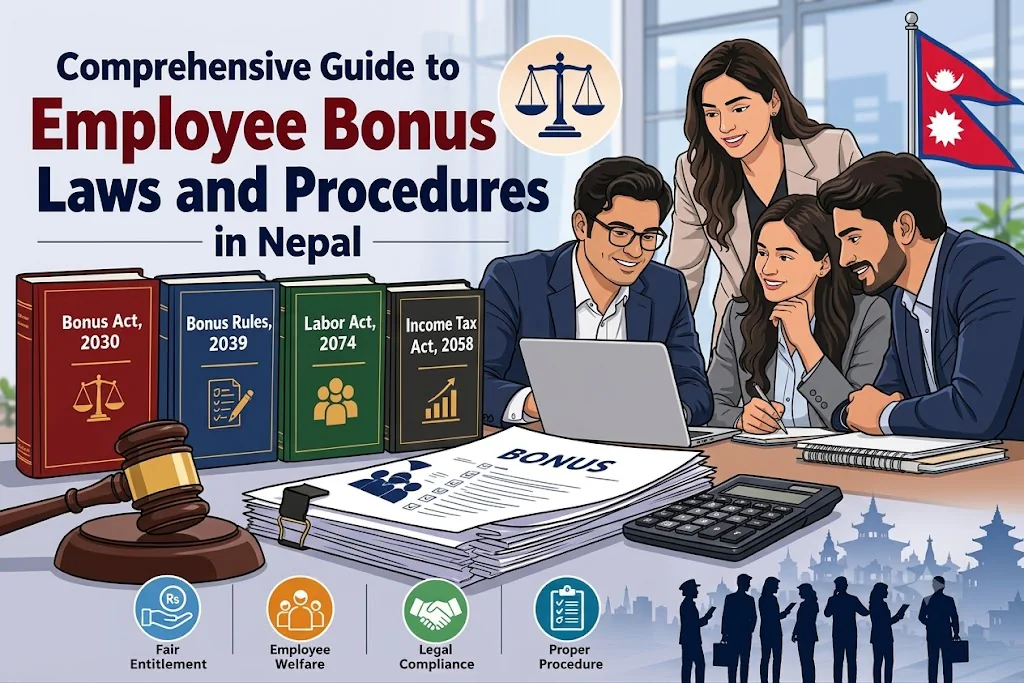
Calculation of bonus and its impact on both employer and employee in Nepal is governed by the following laws:
- Bonus Act, 2030
- Bonus Rules, 2039
- Labor Act, 2074
- Income Tax Act, 2058
Allocation of Bonus for Employees
Every profit-making establishment must allocate 10% of its net profit from a fiscal year as a bonus for its employees. However, in case of a government owned company, the establishment must allocate 5% of its net profit as bonus. Further, the amount to be allocated in case of an establishment which has been given monopoly rights by the government shall allocate only 1% of its profit as bonus (Rule 6).
Generally, it is provided after the financial year is over and the net profit is determined. However, it can also be provided as advance which is determined as five percent of the provisional net profit.
When calculating this net profit, any bonus amount paid in excess of the legally allowed limit must be deducted. If a bonus exceeding the permissible amount has already been distributed, the excess can be recovered in the next fiscal year.
What if the employee has not worked for full year – is he/she eligible for bonus?
If an employee has not worked the required number of days in a fiscal year, their bonus will be reduced proportionally based on the number of days they did not work. This means the bonus amount corresponds only to the actual period of work completed by the employee.
Bonus Eligibility
An employee who has worked at least half of the required working period in a fiscal year is entitled to receive a bonus under this law. However, casual workers or those working on a shift basis are not entitled to the bonus.
For the purpose of calculating the work period the following periods will also be counted as part of the employee’s service period:
- Any period an employee has been kept in reserve as per agreement or Section 15 of the Labor Act, 2074 (2017).
- Any period spent on paid leave.
- Any period the employee was disabled due to an accident related to the establishment’s work.
This means employees who meet these criteria will be eligible for bonus calculation, including certain absences counted as service time. Casual or shift basis employees, however, are excluded from bonus entitlement.
Calculation of Bonus Amount
Here is a simple explanation of how bonus is calculated and examples:
- The management decides the total bonus to be allocated as per the Bonus Act, based on the net profit for the year.
- To find the bonus percentage:
- Take the total amount set aside for bonus distribution in the financial year.
- Multiply it by 100.
- Divide this number by the total salary paid to all employees eligible for bonus.
- The result is the bonus percentage.
- An employee’s bonus amount is calculated by multiplying this bonus percentage by their salary for that year.
However, the bonus cannot exceed certain limits based on the salary level:
- If an employee earns up to double the minimum wage, their bonus cannot be more than 8 months’ salary.
- If an employee earns more than double the minimum wage, their bonus cannot be more than 6 months’ salary.
- In case of an establishment owned by the Government, the maximum bonus eligible by an officer level employee is three times the basic salary and in case of lower-level employee, four times the basic salary.
- In case of an establishment owned by the Government which has been given monopoly rights by the government, the maximum bonus eligible by an officer level employee is two times the basic salary and in case of lower-level employee, three times the basic salary.
- The minimum bonus amount payable to employees in the higher salary categories shall not be less than the maximum bonus amounts payable to employees in the immediately lower salary.
Example
Suppose the establishment has set aside NPR 1,000,000 as the total bonus fund.
The total salary of all eligible employees is NPR 5,000,000.
Bonus percentage = (1,000,000 × 100) ÷ 5,000,000 = 20%.
An employee earning NPR 300,000 a year will get:
Bonus = 20% × 300,000 = NPR 60,000.
But if this exceeds the maximum allowed bonus (8 or 6 months of salary, depending on the employee’s salary level), the bonus will be capped accordingly.
If the total bonus amount set aside is greater than the bonus amount paid to employees, then from the surplus amount:
- Seventy percent is to be contributed to the National Level Welfare Fund and the balance thirty percent is transferred to the Employee Welfare Fund.
- In case of government companies, eighty percent is to be contributed to the National Level Welfare Fund and the balance twenty percent is transferred to the Employee Welfare Fund.
Restriction on Distribution of Bonus
Employees are not eligible to receive a bonus if they have been punished or dismissed due to any of the following reasons:
- Stealing the property of the organization or causing damage to it.
- Taking part in illegal strikes or encouraging others to do so.
- Engaging in riots or breaking workplace discipline.
However, this restriction does not apply to the bonus the employee earned for the period before the punishment or dismissal. They will still receive that portion of the bonus.
Bonus Distribution Procedure
- The bonus must be given in cash.
- The bonus should be distributed within eight months after the end of the fiscal year.
- If the management cannot distribute the bonus within this time, they must apply to the labor office with valid reasons.
- If the labor office finds the reasons acceptable, it can extend the deadline by up to three more months.
- Alternatively, the labor office may allow the management to distribute the bonus for two fiscal years together in the next year.
Who Can Receive a Bonus on Behalf of an Employee?
An employee who is unable to be present to receive a bonus may authorize another person in writing to receive the bonus on their behalf.
In case the employee dies, the bonus due to the employee shall be paid to the person nominated by the employee. If there is no nominee, or the nominee has also died before the employee, then the legal heirs of the deceased employee, determined according to the prevailing inheritance law, will be entitled to receive the bonus.
Anyone dissatisfied with the bonus distribution may file a case in the Labor Court within 35 days from the date of such distribution, and the decision of the Labor Court shall be final.
Condition for Advance Distribution of Bonus
If an establishment cannot submit the audit and profit-loss report on time or if the labor office raises objections delaying bonus distribution, the management must distribute at least 5% of estimated net profit as advance bonus.
After the final audit:
- If the advance bonus distributed is less than the required amount, the management must pay the remaining balance to employees.
- If the advance bonus distributed is more than required, the excess amount can be recovered in the next fiscal year.
Bonus Deduction for Absence and Illegal Strike Participation
If an employee does not work the required number of days in a fiscal year, the bonus entitlement will be reduced proportionally according to the number of days not worked. The remaining bonus amount will be paid to the employee after this deduction.
If any employee participates in an illegal strike at a factory or establishment, the bonus for the days on which the illegal strike occurred will be proportionally deducted, and the employee will receive a bonus only for the remaining days worked.
Resolution of Bonus Disputes
If a dispute arises between employees and management regarding bonus payable under this Act, the Labor Office shall try to resolve the dispute through negotiations involving both parties.
If negotiation fails, the Labor Office may request necessary documents and statements from the concerned establishment and employees, and based on these, make a decision.
Anyone dissatisfied with the Labor Office decision may appeal to the Labor Court within 35 days of receiving the decision. The Labor Court’s decision shall be final.
Penalty
A person violating any order under this Act or rules made hereunder may be fined up to NPR 5,000 by the Labor Department.
Further Appeal
A party dissatisfied with the penalty order by the Labor Department may appeal to the High Court within 35 days of receiving such notice.