1. Introduction
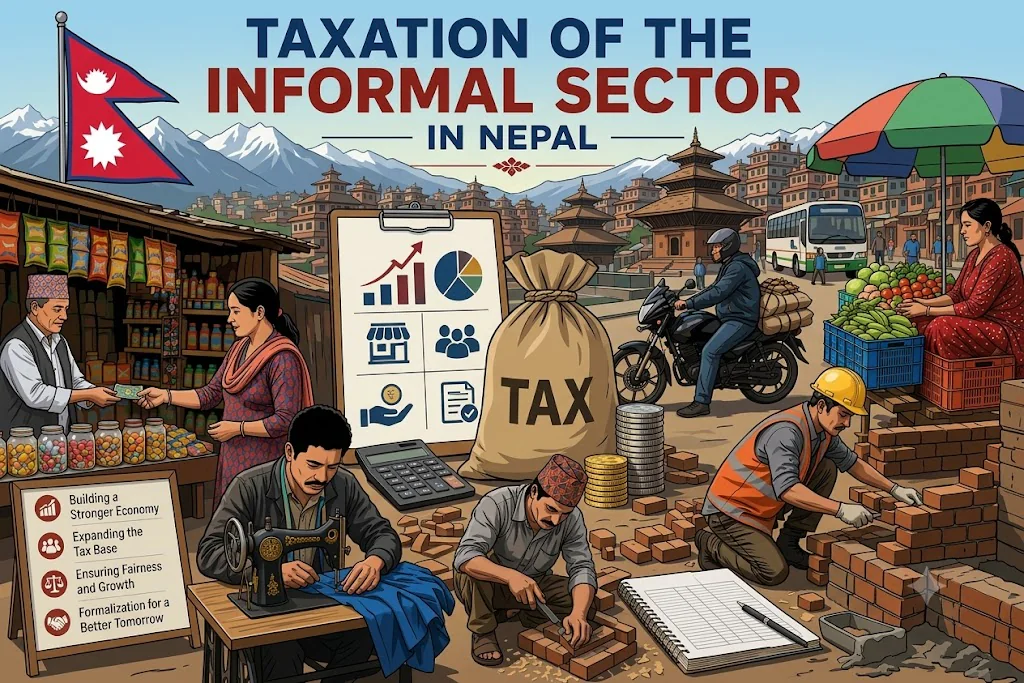
Nepal’s informal sector remains one of the most defining structural characteristics of its economy. It is deeply interwoven with employment generation, household subsistence, and local markets, especially in urban centers and rural trading hubs. The informal sector contributes significantly to the country’s economic activity, yet operates largely outside the formal regulatory, taxation, and social protection systems.
Recent estimates by the World Bank and International Labor Organization indicate that over 80% of Nepal’s workforce is engaged in informal employment. The Nepal Informal Sector Enterprise Survey (2024) highlights that the majority of micro and small enterprises operate without formal business registration, taxation records, or structured employment contracts.
From a legal and taxation policy perspective, this scenario raises two fundamental tensions:
- The State’s need for an expanded tax base to support public finance and social development; and
- Small enterprise owners’ concerns about compliance burdens, lack of support services, and mistrust of regulatory institutions.
Thus, the challenge is not simply to “tax more,” but to design tax policy that encourages formalization through fairness, simplicity, and benefits.
2. Understanding the Informal Sector in Nepal
2.1 Conceptual Definition
In Nepal, the informal sector is not defined by a single statute. However, its characteristics are consistently understood as:
- Enterprises not formally registered with the Company Registrar or PAN or DOI systems.
- No structured book-keeping or audited accounts.
- Cash-based daily transactions with no electronic invoicing.
- Workers employed without social security or labor protections.
- Tax obligations unclear or unassessed.
2.2 Typical Informal Activities
Petty Trade & Retail
Tea shops, mobile vendors, small groceries
Low margins, high cash turnover, no invoices.
Services
Tailors, barbers, repair workshops
Seasonal incomes, informal apprenticeships
Manufacturing
Handicrafts, small-scale carpentry, metalwork
Home-based production, informal labor.
Construction Labor
Masonry, carpenters, transport loaders
Daily wages, no employer contracts.
Agriculture-linked Micro-enterprises
Livestock trading, dairy supply shops
Cash transactions, seasonal variability.
These sectors are not illicit; they simply operate outside formal registration and taxation channels.
3. Statutory Framework Governing Taxation of Informal Enterprises
3.1 Income Tax Act, 2058 (2002)
The Income Tax Act establishes the basic framework for:
- Personal income tax
- Business income tax
- Presumptive taxation for small taxpayers
Small / Presumptive Taxpayer Regime (FY 2081/82)
The Government of Nepal’s budget for FY 2081/82 (Finance Act, 2081) introduced revised small taxpayer categories:
Micro Enterprise
Annual Turnover: Up to NPR 2,000,000
Presumptive tax; simplified filing, no audit requirement
Small Enterprise
Annual Turnover: NPR 2,000,000 – 5,000,000
Simplified income calculation; can opt for account-based taxation
Standard Taxpayer
Annual Turnover: Above NPR 5,000,000
Normal tax rates with accounting and record obligations
The presumptive tax system intends to reduce compliance burden, but in practice, many eligible enterprises do not register at all, meaning even presumptive tax goes uncollected.
3.2 VAT Act, 2052 (1996)
VAT registration thresholds are crucial because VAT is generally seen as a gateway into the formal tax system.
FY 2081/82 VAT Registration Thresholds
Goods/Trading Enterprise
Annual turnover ≥ NPR 50,00,000
Service-only Enterprise
Annual turnover ≥ NPR 20,00,000
Mixed Supply Enterprise
Annual turnover ≥ NPR 30,00,000
Businesses below threshold may voluntarily register, but most choose not to, primarily due to:
- Fear of audits
- Requirement to issue tax invoices
- Record-keeping obligations
- Perception that “VAT registration brings government scrutiny”
3.3 Social Security Act, 2074 (2017)
The SSA mandates employer contributions to the Social Security Fund.
Most informal enterprises:
- Either do not register as employers, or
- Do not file worker contributions.
This disconnect creates long-term social vulnerabilities for workers.
4. The Real Picture: Data and Field Observations
Share of Workforce Informally Employed
80% of national labor force
Source: ILO & World Bank 2024
Share of Enterprises Unregistered
66% of micro-enterprises
Source: Nepal Informal Sector Survey 2024
Share of GDP from Informal Sector
Estimated 30–40%
Source: Government & NRB Estimates
5. Gaps between Law and Reality
5.1 Administrative Weaknesses
- Limited tax field officers related to business population.
- Weak coordination between local governments and the Inland Revenue Department.
5.2 Policy Design Issues
- Presumptive tax bands do not reflect sectorial variation.
- VAT threshold adjustments lag inflation and real turnover dynamics.
5.3 Behavioral and Cultural Barriers
- Taxation is perceived as punitive, not service-based.
- Informal workers fear loss of livelihood under strict regulation.
6. Economic and Social Impacts of Under-Taxed Informality
Fiscal
Narrow tax base, reduced revenue for public goods
Market Competition
Formal businesses face unfair price competition
Worker Welfare
Informal workers lack pensions, insurance, legal protections
State Capacity
Public institutions remain constrained by insufficient resources
7. Policy and Legal Reform Recommendations
7.1 Reform Presumptive Tax System
- Introduce sector-specific graduated presumptive rates.
- Link presumptive tax payment to access to business credit programs.
7.2 One-Stop Digital Registration
- PAN + VAT + Local Business License unified digital platform.
- Mobile-app based invoicing for micro-enterprises.
7.3 Incentivize Formalization
- First-year tax waiver for newly registered micro-enterprises.
- Government-backed micro-loans for registered entities.
7.4 Community-linked Enforcement
- Use local cooperatives and trade unions as compliance partners.
7.5 Protect Informal Workers
- Gradually expand Social Security Fund coverage to informal workers via contribution matching.
8. Conclusion
Taxation of the informal sector in Nepal is not merely a revenue question, it is a state-building and social justice imperative. The legal framework already provides mechanisms such as presumptive taxation and VAT thresholds. However, implementation challenges, social distrust, compliance complexities, and structural economic realities must be addressed through fair, simplified, incentive-driven, and digitally supported reforms.
A forward-thinking approach must balance livelihood protection with fiscal modernization, ensuring that the path to formalization is viewed not as a threat, but as an opportunity for growth, stability, and dignity.