1. Introduction
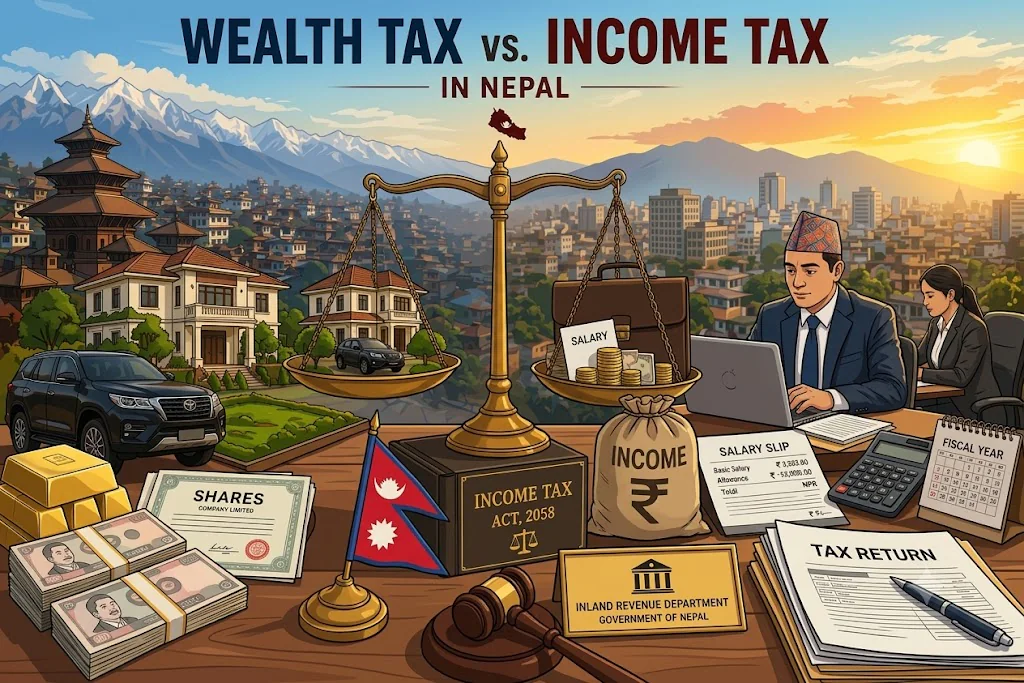
The public discourse on introducing a wealth tax in Nepal has grown stronger in recent years, especially as wealth concentration has increased in urban centers while revenue needs at local and national levels continue to expand. At the same time, income tax remains the central pillar of Nepal’s fiscal system, administered at the federal level, and deeply integrated into payroll, business transactions, and investment returns.
Despite their surface similarity, income tax and wealth tax are fundamentally different in structure, constitutional authority, policy goals, and administrative demands. Understanding this distinction is crucial for policymakers, tax practitioners, investors, and the business community.
The objective is to provide a clear legal and policy roadmap rather than a simple comparison of tax types.
2. Income Tax — A Tax on Economic Flows
Legal Foundation
Income tax in Nepal is governed primarily by the Income Tax Act, 2058 (2002). The Act:
- Identifies taxable income sources (employment income, business income, investment income).
- Sets out taxable periods, allowable deductions, exemptions, and withholding mechanisms.
- Provides compliance procedures, including return filing, assessment, and appeals.
Administrative Structure
Income tax is a federal tax, administered by the Inland Revenue Department (IRD) under the Ministry of Finance. It is enforced through:
- Taxpayer Self-Assessment,
- Withholding (Tax Deducted at Source – TDS),
- Regular audits and investigations,
- Penalties for non-compliance.
Nature of Taxation
Income tax targets flows of economic activity income that a person or entity receives during a given fiscal year.
Examples:
- Salary earned by an employee,
- Profit earned by a business,
- Rent income from property,
- Dividends and interest income.
Thus, income tax assesses the annual ability to pay, not cumulative wealth.
3. Wealth Tax: A Tax on Economic Stock
Conceptual Framework
A wealth tax is imposed on a person’s net worth at a certain valuation date:
Total Value of Assets – Total Liabilities = Net Taxable Wealth
Wealth taxes may be:
- Broad (taxing total net worth annually),
- Selective (taxing particular assets such as real estate, luxury goods, or financial holdings),
- One-time or temporary levies (e.g., solidarity taxes after crises).
Key Policy Objective
Wealth tax aims to address wealth concentration and socio-economic inequality, rather than simply raising revenue.
Nepal’s Constitutional Position
The Constitution of Nepal (2015) places wealth-related taxes, particularly property and house taxes, under Local Government Powers (Schedule-8). This means:
- Local governments already have the authority to tax certain components of wealth.
- Nepal does not currently have a national net-worth wealth tax imposed by the federal government.
This constitutional allocation significantly shapes what is legally possible and advisable.
4. Practical Differences between Income Tax and Wealth Tax
Basis of Comparison
Income Tax
- What is taxed: Annual income (flows)
- Authority: Federal (IRD)
- Administrative Data Required: Transaction and income records
- Enforcement Difficulty: Moderate
- Primary Purpose: Revenue mobilization
Wealth Tax
- What is taxed: Accumulated net worth (stock)
- Authority: Local governments (primarily property); national wealth tax would require new legislation
- Administrative Data Required: Market valuation of assets and debt disclosure
- Enforcement Difficulty: High (valuation disputes, concealment risks)
- Primary Purpose: Redistribution + revenue
Note: What is being redistributed?
When we say a wealth tax has a “redistribution” function, it refers to the redistribution of economic resources and opportunities across society. Redistribution is not about taking wealth from the rich in a punitive way; it is about rebalancing the tax burden to ensure fairness and strengthening the State’s capacity to provide equal opportunities.
5. Administrative and Valuation Challenges in Nepal
Introducing a broad wealth tax is not simply a legislative act, it requires institutional capacity.
Asset Valuation (Asset valuation refers to the process of determining the current monetary value of an asset for taxation purposes. Wealth taxation depends almost entirely on accurate and credible valuation.)
For Example: A three-storey house in Kathmandu might have a government valuation of NPR 1 crore, but its actual market value may be NPR 4–6 crore. This undervaluation directly reduces the amount of wealth/property tax collected.
Accurate valuation requires:
- Reliable land and building valuation systems,
- Transparent commercial property market pricing,
- Valuation standards for private companies, shares, gold, art, foreign assets, etc.
Nepal’s valuation systems are uneven and often outdated, especially at municipal levels.
Beneficial Ownership and Asset Concealment
A wealth tax requires clarity on:
- Who ultimately owns an asset,
- Whether assets are held in nominee names,
- Whether assets are parked abroad.
Nepal currently lacks:
- A fully operational beneficial ownership registry,
- Strong international information exchange mechanisms.
Cost vs. Revenue
Several countries that attempted broad wealth taxes later repealed or narrowed them because:
- Administrative costs exceeded expected revenue,
- Wealth flight and avoidance increased.
Countries that Abolished Wealth Tax Due to Practical Difficulties
India (Repealed 2015)
Admin cost > revenue
Under-reporting and asset fragmentation
Shifted to higher surcharges on high-income earners
Germany (Abolished 1997)
Constitutional Court held wealth tax unconstitutional due to valuation inequality
Land and financial assets could not be valued equally
Sweden (Abolished 2007)
Wealthy taxpayers moved assets outside the country
More compliance costs than revenue
Denmark (Abolished 1997)
High evasion, capital flight, and valuation disputes
Thus, implementation must be phased and strategically targeted.
6. Why the Debate Matters? Equity, Growth, and National Priorities
Equity Considerations
Nepal shows increasing wealth concentration in:
- Real estate located in Kathmandu, Pokhara, and urban corridors,
- Business conglomerates and financial holdings.
A carefully designed wealth-related taxation system could:
- Improve social fairness,
- Reduce dependency on indirect taxes (like VAT), which disproportionately affect lower-income groups.
Economic Efficiency
However, taxation must avoid discouraging:
- Productive investment,
- Industrial expansion,
- Entrepreneurship.
Thus, broad wealth taxation must exempt or treat differently:
- Productive business assets,
- Agricultural land held for genuine livelihood use,
- Shares used in active business operation.
7. What Nepal Can Realistically Implement — a Phased Strategy?
Given current legal and administrative capacity, a pragmatic and lawful pathway is advisable.
Step 1 — Strengthen Local-Level Property Taxation
Local governments already have authority to collect:
- Property tax,
- Land and house taxes,
- House rent tax.
To improve revenue:
- Standardize valuation guidelines nationwide,
- Digitize property registration and records,
- Develop market-linked valuation indices.
This respects the Constitution and produces immediate fiscal benefits.
Step 2 — Enhance Income Tax Administration
Before designing new taxes, Nepal should:
- Improve TDS systems,
- Strengthen audit enforcement,
- Introduce digital invoice matching,
- Expand taxpayer education.
This can yield substantial revenue without new tax categories.
Step 3 — Pilot Targeted Wealth Tax Instruments
Instead of launching a universal wealth tax, Nepal could begin with:
- A high-threshold net-worth surcharge (e.g., only the top 1%),
- Higher taxes on luxury real estate above a defined bandwidth,
- Special capital gains tax for inter-generational asset transfers,
- One-time solidarity levy in times of fiscal stress.
These approaches are:
- Legally simpler,
- Administratively feasible,
- Less likely to trigger capital flight.
8. Legal Drafting Considerations for Any Future Wealth Tax Law
If Nepal moves toward a national wealth tax, the legislation must address:
- Clear Definitions
What counts as wealth, deductible liabilities, and exemptions. - Fair Thresholds
Exempt middle-class households and agricultural family holdings. - Valuation Methodology
Objective, reviewable, and consistent valuation standards. - Appeal and Review Mechanisms
Valuation disputes must have transparent resolution pathways. - Anti-Avoidance Measures
Penalties for concealed ownership or under-reporting. - Coordination Between Federal and Local Governments
Avoid double taxation and ensure constitutional compliance.
9. Conclusion
Nepal does not need to choose between income tax and wealth tax as mutually exclusive tools. Instead, the optimal path forward is sequenced and capacity-based:
- Strengthen local governments’ existing property and wealth-related taxation authority,
- Improve income tax enforcement to ensure fairness and broaden the tax base,
- Gradually introduce targeted, high-threshold, administratively feasible wealth taxation measures.
This ensures:
- Legal soundness,
- Protection of economic growth,
- Greater fiscal equity,
- Sustainable revenue mobilization.
A carefully designed policy approach can promote economic fairness without discouraging legitimate investment, and can position Nepal’s taxation system on a more equitable and modern footing.