

Introduction
Legal Compliance, that is, Company compliance, is the adherence to laws, regulations, and ethical standards applicable to a business. It is always a matter of significant importance at both the national and international levels, as companies must follow the regulatory frameworks established by the government. In Nepal, the Companies Act, 2063 (2006), provides the foundational provisions for compliance. They include requirements such as proper registration with the Office of the Company Registrar (OCR), the regular filing of tax returns, maintaining accurate records, holding required meetings, and reporting any significant changes within the company.
Legal Frameworks
The registration, operation, and dissolution of public limited companies in Nepal are governed by:
Companies Act, 2063 (2006)
Company Rules, 2065
Securities Act, 2063 (if issuing shares to public)
Securities Registration and Issue Regulations, 2073
Relevant sectoral laws (e.g., Banking Act, Insurance Act for specific industries)
Requirements of A Public Limited Company
| Feature | Requirement |
|---|---|
| Minimum Promoters | 7 Nepali/foreign individuals or entities |
| Maximum Number of Shareholders | Unlimited |
| Minimum Paid Up Capital | NPR 10 Million (1 Crore) |
| Transfer of Shares | No consensus required among shareholders for transfer of share |
| Can Invite Public to Subscribe Shares & Debentures | Yes |
| Name of Company | Company name must end with ‘Limited’ |
| AGM Requirement | Compulsory every year |
| Regulatory Oversight | OCR, SEBON, IRD and sector regulations |
Steps of Registration Process at OCR
Step 1: Name Reservation
Apply online at OCR Website (https://ocr.gov.np).
Ensure the name is unique, not misleading, and not similar to an existing company or trademark.
The name must include the word “Limited“.
Proposed name, objectives, and applicant details.
Output: Name Approval Letter (valid for 35 days)
Step 2: Prepare Incorporation Documents
Memorandum of Association (MOA): Contains company objectives, capital structure, liability clause, and name of promoters.
Articles of Association (AOA): Includes management rules, board composition, meeting procedures, dividend policy, etc.
Step 3: Compile and Submit the following documents to OCR:
| S.N | Document/Requirement | Details/Remarks |
|---|---|---|
| 1 | Application for Company Registration | In prescribed format |
| 2 | MOA & AOA | Signed by all promoters on every page |
| 3 | Copy of National ID Card | Of all Nepali promoters |
| 4 | Passport/Visa & Address Proof | For Foreign promoters (if any) |
| 5 | Agreement Among Promoters | Optional, if any agreement exists |
| 6 | Power of Attorney | If submission is done via representative |
Step 4: Pay The Registration Fee
Based on the authorized capital, the registration fee ranges as follows:
| Authorized Capital in NPR | Registration Fee in NPR |
|---|---|
| Up to 1 Crore (10 Million) | 15,000 |
| Above 1 Crore up to 10 Crores | 40,000 |
| Above 10 Crores | 40,000 + NPR 30 for each additional 1 Lakh |
Step 5: Examination By OCR
- OCR examines all documents.
- May issue a query for clarification or rectification.
Step 6: Issuance Of Certificate Of Incorporation
If all documents are in order, OCR issues:
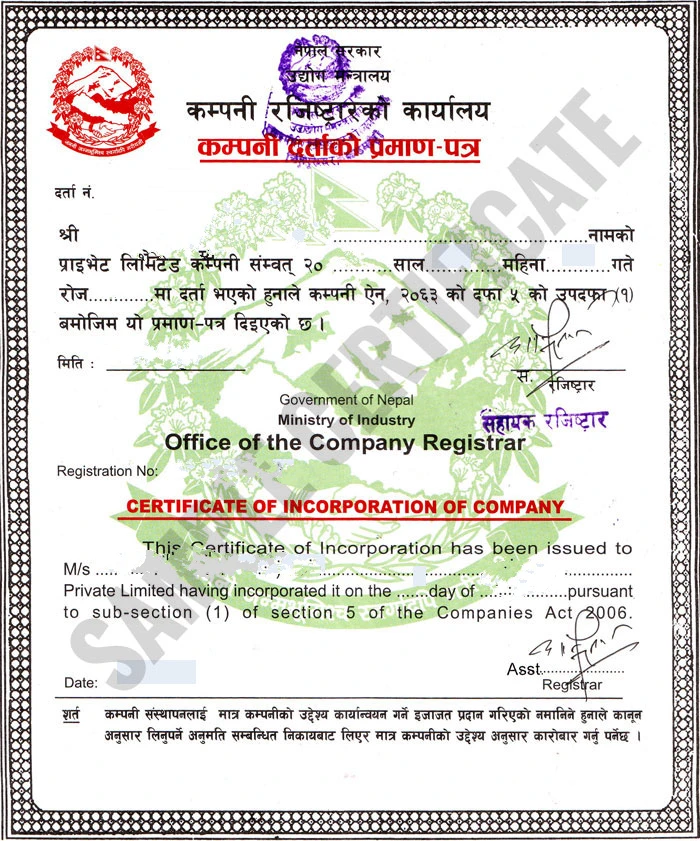
- Certificate of Incorporation
- PAN/VAT Number
- Company Registration Number
By following the above-mentioned steps, a legally recognized Public Limited Company is established in Nepal.
Sector-Specific Compliance
- For companies in banking, insurance, hydropower, telecommunications, and other regulated industries:
- Additional licenses or approvals from Nepal Rastra Bank, Insurance Board, Electricity Regulatory Commission, etc., are mandatory.
- Capital requirements may be higher than NPR 10 million.
Conclusion
In conclusion, legal compliance for public companies in Nepal is a broad and continuous process. It spans corporate, financial, and employment standards, as well as sector-specific regulations. Adherence to major acts of compliance, such as conducting annual general meetings, publishing financial reports, and tax filing, is mandatory. By meeting these legal obligations, a public company not only establishes a credible and sustainable presence but also fosters an accountable business sector in Nepal.