
1. Introduction
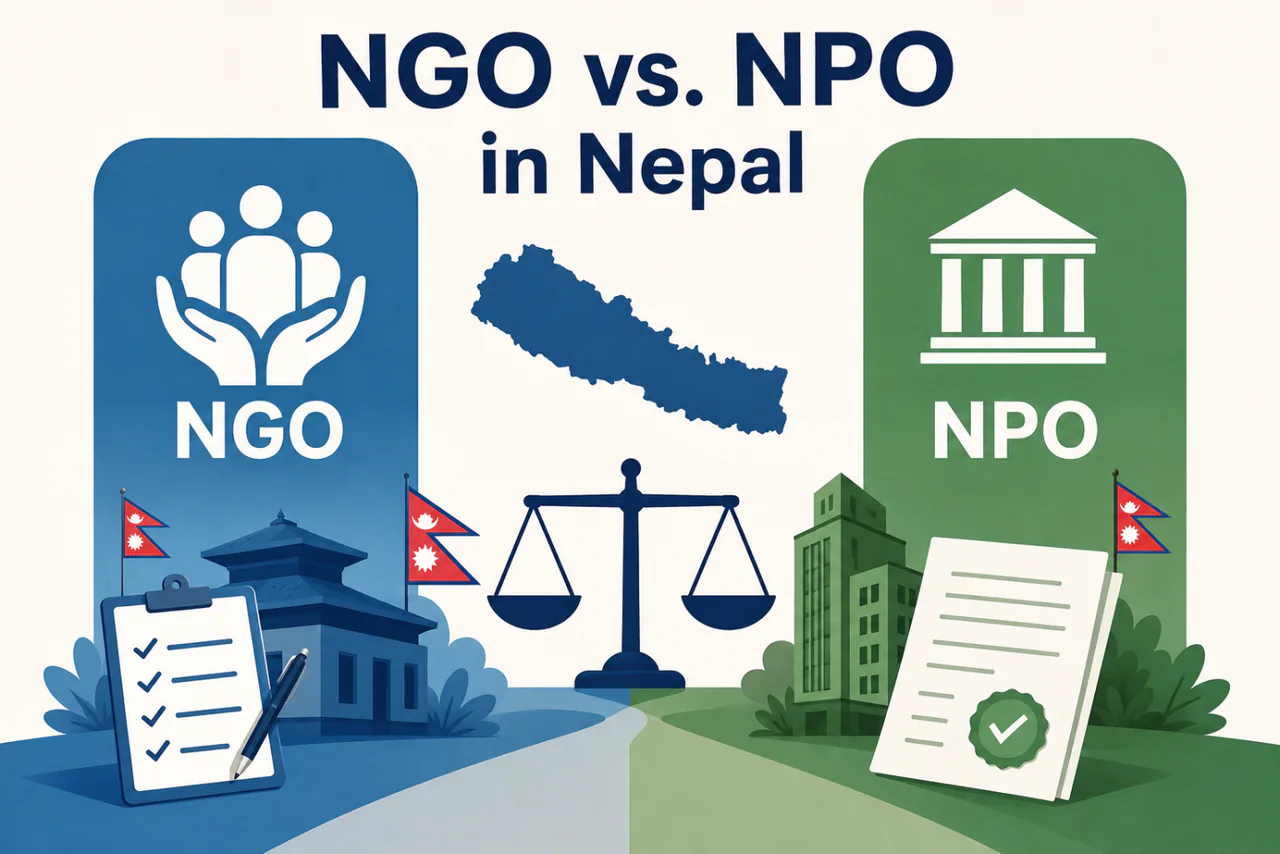
In Nepal, many groups working in areas like education, health, social development, or humanitarian aid often call themselves NGOs or NPOs. However, these terms are not the same in law each has a different legal setup and is regulated by different authorities.
An NGO is registered as an association at the District Administration Office (DAO) under the Associations Registration Act, 2034 (1977). In contrast, an NPO is established as a company that does not distribute profits under the Companies Act, 2063 (2006).
This difference matters because the type of registration determines how the organization is managed, regulated, and taxed.
In this article, we’ll clearly compare these two legal forms, explain their tax obligations and governance requirements, and share practical tips and sample clauses to help organizations stay compliant, reduce risks, and build strong credibility.
2. Legal Vehicles: Association (NGO) vs. Company Not Distributing Profits (NPO)
NGO / Association (DAO route)
- Governing Statute: Associations Registration Act, 2034 (1977).
- Registration Authority: District Administration Office / Chief District Office (DAO).
- Share Capital / Equity:
No share capital; membership fees, grants, donations. - Surplus / Profit Distribution:
Prohibited surplus must be used for objectives, not distributed. - Foreign Funding / SWC:
NGOs receiving foreign grants must affiliate with the Social Welfare Council (SWC) and follow SWC Project Agreement rules. - Governance Flexibility:
Traditions of associations, potentially stricter membership rules under Associations Act. - Audit / Annual Return:
Must maintain audited accounts; file reports with DAO and, if SWC affiliated, with SWC. - Winding Up / Asset Disposition:
If an organization is registered under the old Associations Registration Act, 2034 (1977), Section 14 explicitly states that if an association is dissolved “for any other reasons whatsoever, all the assets of such Association shall devolve on Government of Nepal,” and the Government will bear liabilities to the extent of those assets.
NPO / Company Not Distributing Profits (OCR route)
- Governing Statute: Companies Act, 2063 (2006), specifically Chapter 19.
- Registration Authority: Office of the Company Registrar (OCR).
- Share Capital / Equity:
No share capital; can have membership fees, subscription models. - Surplus / Profit Distribution:
Prohibited surplus must be reinvested or applied to objectives; cannot be divided among members. - Foreign Funding / SWC:
NPO companies receiving foreign grants similarly must interact with SWC / comply with project approval and monitoring conditions. - Governance Flexibility:
More structured corporate form, easier governance mechanisms (e.g. members as “shareholders” in non-profit sense). - Audit / Annual Return:
File annual financial statements, compliance reports to OCR and IRD; audit requirement applies. - Winding Up / Asset Disposition:
For a company not distributing profits under the Companies Act, remaining assets (after debts) must be applied according to the Articles, and if the Articles are silent, the assets devolve on the Government of Nepal, subject to the Act’s provisos preventing transfer to promoters or relatives.
Point to be remembered:
The Social Welfare Act, 2049 (1992) and the Social Welfare Council regime give the Council and the Government power to suspend or dissolve affiliated social organizations in prescribed circumstances. Regulatory practice treats State supervision as strong, particularly in relation to foreign funding and oversight.
Statutory anchor:
The Companies Act’s Chapter 19 is critical when drafting or advising an NPO.
3. Tax Treatment: Exemption, Certification, and Compliance
3.1 Tax Exemption Is Not Automatic
Even if an organization is registered as non-profit, it does not automatically receive tax benefits. To qualify for tax exemption, the organization must apply for and obtain a tax-exempt certificate from the Inland Revenue Department (IRD) under the Income Tax Act and its Rules. The IRD has full authority to approve, renew, or cancel that exemption certificate.
3.2 What Income May Be Exempt
Generally, donations, grants, and funds used for genuine non-profit purposes are tax-exempt. However, if the organization earns income from business or commercial activities that are not directly related to its non-profit objectives, that income must be reported separately and may be subject to tax, unless the IRD grants special approval or the law specifically exempts it.
3.3 Withholding (TDS) and Reporting Obligations
Being tax-exempt does not mean the organization is free from all tax responsibilities. NGOs and NPOs must still deduct and remit taxes (TDS) on certain payments such as salaries, professional fees, or rent, and must file regular financial and tax reports with the IRD.
3.4 Other Reliefs and Concessions
Non-profit organizations may apply for customs duty waivers, VAT exemptions, or import relief for goods and materials used in their projects. These benefits are granted case-by-case and often depend on recommendations from the Social Welfare Council or approval from the relevant ministry.
3.5 Renewal, Revocation, and Compliance Risks
Tax exemption certificates usually need to be renewed periodically. Failure to meet compliance standards such as audits, timely filing, or accurate records can lead to suspension or cancellation of tax-exempt status, resulting in back taxes, penalties, or loss of donor trust.
5. Practical Template Clauses
Non-distribution Clause
The organization is established purely for non-profit purposes. No part of its income, property, or assets shall be distributed to its members as profit, dividend, or bonus. In the event of dissolution, any remaining assets shall be transferred to another non-profit or public benefit organization with similar objectives, or as approved by the concerned authority.
Winding Up / Asset Transfer Clause
If the organization is liquidated or dissolved, all its debts and liabilities shall be settled first. Any remaining property or assets shall then be transferred to another organization with similar goals. If no such organization exists, the assets will be handed over to the Government of Nepal or as directed by the relevant authority.
Foreign Grant / SWC Compliance Clause
When receiving foreign funds or grants, the organization shall obtain all necessary approvals and affiliations from the Social Welfare Council or other concerned government bodies. It will fully comply with the terms of the project agreement, including limits on administrative expenses, financial reporting, auditing, and monitoring requirements.
6. Choosing the Right Legal Structure (Forward-Looking Advice)
Choosing between registering as an NGO or an NPO depends on the nature and scale of activities:
- If the organization plans to run social enterprises, engage in income-generating projects, or expand operations nationally or internationally, forming an NPO under the Companies Act provides a stronger and more flexible corporate framework.
- If the organization is small, locally focused, and mostly volunteer-driven, registering as an association under the Associations Registration Act may be more practical and cost-effective.
Regardless of structure, it is important to plan ahead:
- Draft constitutive documents carefully with clear clauses on non-profit objectives, governance, and dissolution.
- Include flexibility to expand or change programs in the future.
- Establish strong internal controls including regular audits, compliance systems, and conflict-of-interest policies from the beginning.
7. Conclusion
In Nepal, using the term NGO or NPO is merely the surface; what truly defines an organization is the legal structure behind it. Whether registered as an association with the DAO or as a non-profit company with the OCR, the choice fundamentally shapes how the organization is regulated, taxed, governed, financed, and dissolved.
A well-informed decision at the formation stage determines not only compliance burden but also the capacity to grow, attract funding, and sustain operations. Non-profits must balance charitable goals with professionalism, transparency, and legal accountability.
To establish a strong and credible organization, it is essential to:
- Choose the right legal vehicle aligned with mission and future plans.
- Draft clear, compliant, and forward-looking governing documents.
- Uphold sound governance and financial discipline through transparency, audits, and reporting standards.