
Introduction
Starting a business in Nepal is an exciting venture, but before taking the first step, it’s crucial to understand the legal foundation on which your business will stand. The Companies Act, 2063 (2006) of Nepal provides for various types of companies, each with its own structure, liability framework, compliance requirements, and operational scope.
Choosing the appropriate type of company is not just a formality; it directly affects your legal obligations, investment capacity, decision-making authority, and even your future expansion opportunities. This guide aims to provide a clear and practical overview of the major types of companies recognized under Nepalese law, helping entrepreneurs, investors, and legal professionals make informed decisions that align with both their business goals and legal responsibilities.
Prior to examining the various types of companies, it is essential to grasp the fundamental concept of what constitutes a company. A company is a legal organization formed by a group of people to do business. It can buy and sell things, enter into contracts, own property, and even go to court just like a person. The company is treated as a separate “legal person,” which means it has its own rights and responsibilities, separate from the people who own or manage it. According to company act 2063(2006) “Company means company incorporated under this act”.
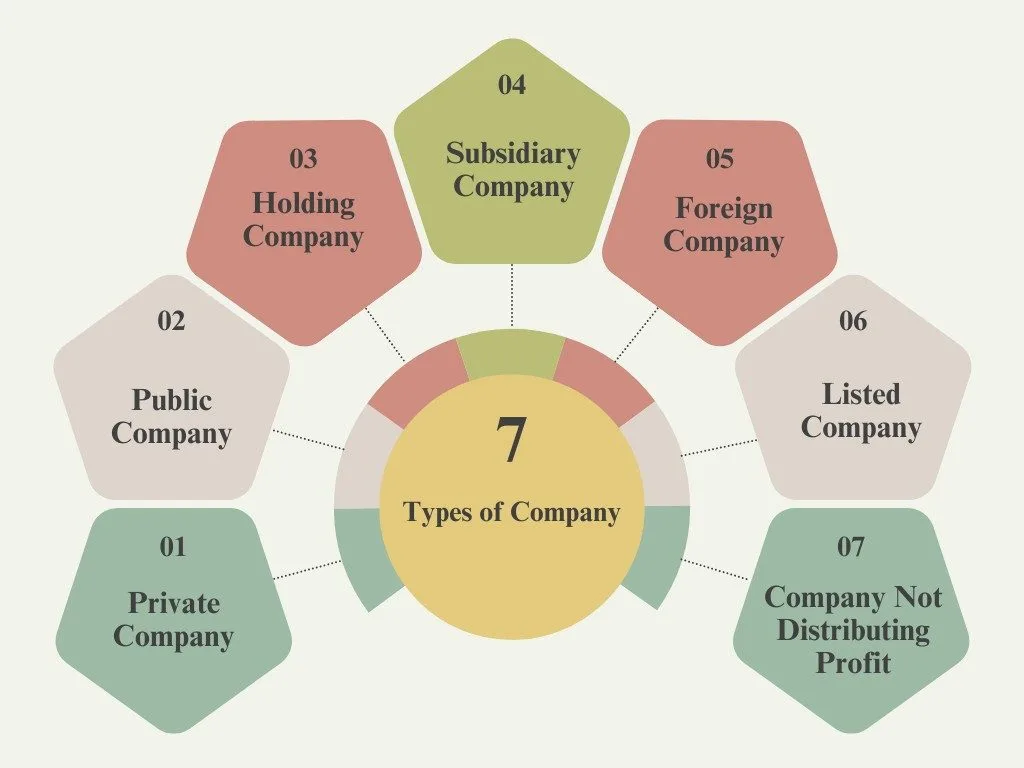
The Company Act of 2063 set forth the various classifications of companies that are permitted in Nepal:
- Private Company
- Public Company
- Holding Company
- Subsidiary Company
- Foreign Company
- Listed Company
- Company Not Distributing Profits
Private Company
A Private Company in Nepal is a corporate entity owned by private individuals and governed by the provisions of the Companies Act, 2063 (B.S.). Unlike public companies, private companies are restricted from offering their shares to the general public or listing on stock exchanges. These entities are typically formed to pursue specific objectives as set forth in their memorandum of association and articles of association.
Core Characteristics of a Private Company:
1. Limited Liability
One of the most significant legal protections offered by a private company structure is limited liability. Shareholders are not personally liable for the company’s debts or obligations. The company is treated as a separate legal entity under Nepalese law, capable of owning property, entering contracts, and bearing responsibility in its own name.
2. Restricted Shareholding
Private companies are restricted in terms of ownership and governance:
- The number of shareholders cannot exceed 101.
- The board of directors must consist of no more than 11 members.
These limitations are designed to preserve the closely held nature of the company and maintain streamlined decision-making processes.
3. No Public Trading
Private companies are prohibited from offering shares to the public. This means:
- Shares cannot be sold on stock exchanges.
- The company cannot solicit investments from the general public.
This restriction ensures that ownership remains private and that regulatory obligations are minimized.
Conversion to a Public Company: A Strategic Possibility
Thinking about scaling up? A private company can be converted into a public company, a strategic move for growth and broader capital access. This transition requires:
- The adoption of a special resolution at a General Meeting.
- Compliance with all legal requirements set out by the Companies Act and related regulatory frameworks.
Additionally, if more than 25% of the company’s shares are held by public companies, the company will be legally classified as a public company even if it was originally incorporated as private.
Registration of Private Company
1. Name Reservation (Pre-Approval)
Submission of Application:
File an online or physical application to OCR for name approval using the OCR’s portal https://ocr.gov.np/.
Required Details:
- Proposed company name (in Nepali and English).
- Objectives of the company.( as per NSIC code)
Legal Consideration:
The proposed name must not infringe on existing trademarks or registered company names. Names that are misleading or contrary to public morality are restricted.
2. Drafting of Company Documents
The following charter documents must be prepared in compliance with the Act:
- Memorandum of Association (MOA): Contains objectives, capital, liability clause, etc.
- Articles of Association (AOA): Contains rules governing internal management.
Additional Documents:
- Citizenship Certificates of all shareholders and directors.
- Photographs (passport-size).
- Consent letters from directors.
- Lease agreement or proof of the company’s registered office.
3. Online Submission to OCR
- Register and create a user account on OCR’s portal.
- Fill out the company registration form (details of promoters, share structure, address).
- Upload all necessary documents (MOA, AOA, etc.).
4. Payment of Registration Fees
- The fees are calculated based on the authorized capital of the company.
- For example, up to NPR 1,00,000 authorized capital: fee is NPR 1,000.
- The fee increases progressively with higher capital bands.
- Payment can be made online or through a designated bank.
5. Verification by OCR
- The OCR examines all submitted documents for legal and procedural compliance.
- OCR may request clarification or additional documentation if discrepancies are found.
6. Certificate of Incorporation
- Once approved, the OCR issues a Certificate of Incorporation.
- This certificate grants legal status to the company.
- You also receive a PAN number and company registration number.
Post-Registration Compliance:
- Tax Registration (PAN/VAT with the Inland Revenue Department).
- Social Security Fund registration, if applicable.
- Local Government Permissions if required based on business nature.
- Share Certificates must be issued to shareholders within two months.
- Company Seal must be created.
2. Public Company
A Public Company is a distinct legal entity established with the primary objective of raising capital from the general public through the issuance of shares, bonds, or debentures. Governed by the Companies Act, 2063 (2006) of Nepal, public companies play a vital role in mobilizing public savings for large-scale commercial activities and national economic development.
Key Legal Features of a Public Company
Minimum Capital Requirement:
Public Companies in Nepal are required by law to maintain a minimum paid-up capital of NPR 1 Crore. This statutory threshold is intended to ensure financial credibility and safeguard public interest.
Public Offering and Listing:
Shares and other securities of a public company must be offered to the general public and are subject to regulatory oversight. Before such securities can be traded on the stock exchange, the company must obtain approval from the Securities Board of Nepal (SEBON) and ensure its shares are listed on the Nepal Stock Exchange (NEPSE).
Free Transferability of Shares:
Once shares are issued to the public and listed, they become freely transferable.
Unlimited Number of Shareholders:
Unlike private companies, a public company can have an unlimited number of shareholders.
Re-conversion to Private Company:
A public company may revert to private status under specific conditions:
- If the number of shareholders falls below seven, or
- If the company fails to maintain the minimum paid-up capital of NPR 1 Crore.
The company must initiate re-conversion within six months from the triggering event.
3. Holding Company
A Holding Company, as defined under the Company Act, 2063 (Section 2) of Nepal, is a company that exercises control over another company, known as a Subsidiary.
Control may be exercised through:
- Control over the Board of Directors.
- Ownership of majority shares.
A holding company primarily manages and oversees subsidiaries rather than conducting daily business operations.
4. Subsidiary Company
A Subsidiary Company is a company that is controlled by another company, its parent or holding company.
Control is exercised through:
- Majority shareholding, or
- Power to appoint directors.
While operationally independent, a subsidiary remains accountable to its holding company.
5. Foreign Company
A Foreign Company, as defined under Section 154 of the Company Act, 2063, refers to any company incorporated outside Nepal that carries on business within Nepal.
Operation may be:
- Physical (branch or agent),
- Electronic, or
- Through any business activity connected to Nepal.
To operate legally, a foreign company must:
- Obtain FDI approval.
- Apply to the Office of the Company Registrar (OCR).
- Register a branch office in Nepal.
6. Listed Company
A Listed Company in Nepal is a public limited company whose securities are listed and traded on the Nepal Stock Exchange (NEPSE).
The process includes:
- Incorporation as a public limited company.
- Approval from SEBON.
- Initial Public Offering (IPO).
- Listing on NEPSE.
7. Company Not Distributing Profits (Not-for-Profit Company)
Under Section 166 of the Companies Act, 2063, a Company Not Distributing Profits is established for professional, social, academic, benevolent, or public welfare objectives and shall not distribute dividends.
Key Legal Provisions (Section 167):
- No share capital requirement.
- Limited liability of members.
- Prohibition on profit distribution.
- Restriction on mergers.
- Governance through member voting.
- Operational expense limits set by OCR.
- Asset distribution upon liquidation as per AOA or to Government of Nepal.
Registration Process:
- Name Reservation through OCR.
- Preparation of MOA and AOA.
- Submission to OCR.
- PAN Registration.
- Local Level Registration.
- Social Welfare Council Registration (if applicable).
Required Documents:
- Memorandum of Association (MOA) – 2 copies
- Articles of Association (AOA) – 2 copies
- Citizenship Certificates of all promoters
- Application Letter for company registration
- Power of Attorney (if applicable)
Fees:
- OCR Registration Fee: NPR 15,000