
Quick answer
What does the Industrial Enterprises Act 2076 regulate?
The Industrial Enterprises Act 2076 governs the registration, classification, approval, operation and closure of industries in Nepal. The responsible office and required approval depend on the industry type, scale, location and regulated activity.
- Confirm the proposed industry classification before submitting the registration.
- Identify environmental, sector and local approvals that may be required in addition to industry registration.
- Keep registration, reporting and renewal records available for inspection.
1. Introduction
Industrial Enterprises Act, 2076 (2020) was introduced by repealing the Industrial Enterprises Act, 2016 (the “Previous Act”). The Act is a principal legislation for registration, establishment and pre/post operational compliances of industry. No person (either natural or legal) is permitted to operate its business without establishing industry under this Act. The IEA 2020, has decentralized the registration process by granting authority to provincial levels for registration, renewal and regulation of industries.
2. Provision Relating to Registration of Industries
Section 4 deals that; a person, firm or company that intends to establish any of the following industries under this Act shall make an application to the Department of Industry (DOI) for registration with all relevant documents as prescribed:
- An industry mentioned in Schedule 1 that requires permission,
- An industry established with foreign investment,
- An industry related to any matter set forth in Schedule 5 of the Constitution of Nepal,
- An industry that falls under the jurisdiction of two or more Provinces,
- An industry related to academic consultancy services on diplomatic affairs.
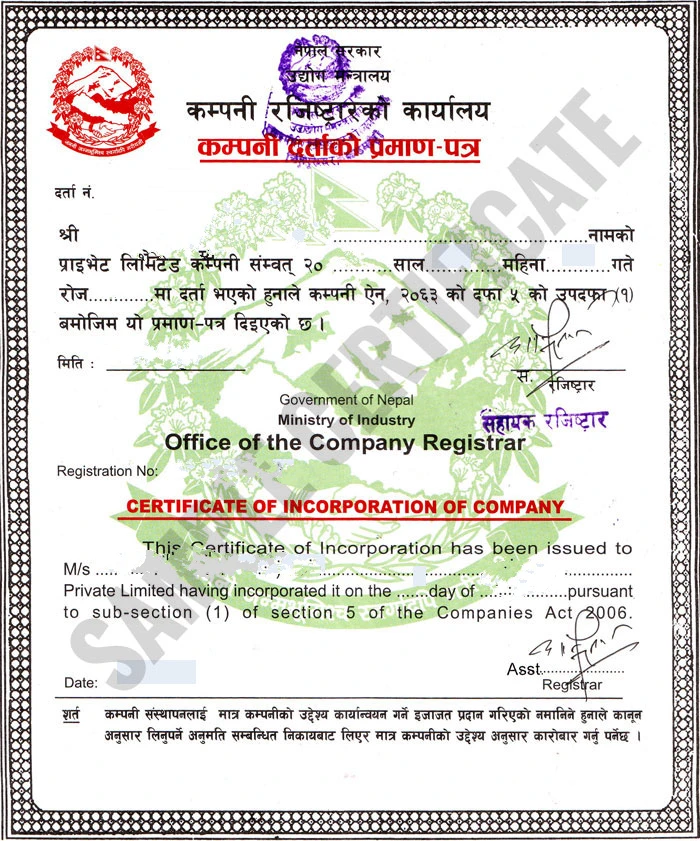
All other industries shall be registered at the provincial level and regulated thereunder. Whereas industries related to atomic energy, radioactive materials production shall be established and operated under GON. DOI shall notify applicants to submit additional documents if the application is not complete within 90 days from the date of the application. Where an application is rejected, DOI must inform the applicant with sufficient reasons within 5 days of such decision. Moreover, the DOI or the provincial regulator shall issue a certificate of registration within 5 days of receipt of the application as per Section 5.
3. Permission Required to Establish an Industry
- Under Section 7, Permission for pollution control
- Under Section 8, Establishment of specified industries
- Under Section 11, shifting the industry
- Under Section 12, Increment of capital / capacity of production or addition or change of objectives.
4. Classification of Industries
Under that Chapter 3 of the IEA 2020, Industries are classified either on the basis of capital or the nature as follows:
4.1 On the basis of capital, Section 17(1)
- Cottage
Traditional skill and tech based, labor intensive using local resources, technology and energy usage of <50kwh - Micro
Fixed Capital <2 million
Value excluding house and land owned by proprietor, 9 employees, annual transaction less than NPR 10 Million - Small
Fixed Capital <150 million
Industries other than micro and small industries - Medium
Fixed Capital 150 – 500 million - Large
Fixed Capital above 500 million
4.2 On the basis of nature of product or services [Section 17(2)]
- Energy Based
Industries mentioned in Schedule III - Manufacturing
Industries producing goods using raw materials or semi or processed raw materials - Agro Forest Based
Industries based on agriculture or forest products: Industries prescribed in Schedule IV - Mineral Industry
Industry producing metal or minerals other than metals through excavation or processing - Construction Industry
Industries prescribed in Schedule – V operated using constructed physical infrastructure - Tourism Industry
Industries related to tourism services as prescribed in schedule VI - Information Technology, Information Transmission and IT service-based industry
Industries prescribed in Schedule VII - Service Oriented Industry
Service production or service provider-based industries as prescribed in Schedule VIII
5. Returns to be filed with DOI
5.1 Information relating to commencement operation, production or transactions (Section 9)
Every industry shall commence its operation within the time specified in the registration certificate and submit the information to registration authority within 30 days thereof. If not, it should apply for extension before expiry of 30 days which can be extended within 6 months of expiry with late fee.
5.2 Details to be provided (Section 13)
Every industry after commencing its commercial production shall furnish the specified details and documents to the registration authority within 6 months after end of each financial year either physically or in electronic form.
5.3 Information regarding closure of industry (Section 14)
Information of closure shall be provided within 30 days of such closure or suspension of its operation to the Registration Authority.
6. Monitoring and Supervision (Section 10)
The monitoring and supervision of the industries including compliance with laws and rules shall be conducted by the Ministry of Industries, Commerce & Supplies or DOI.
7. Application for cancellation of registration of industry (Section 15)
If an industry has to cancel its registration for non-operation for any reason it shall notify the registering authority. After clearance of tax liability and other government liability, registration can be cancelled and DOI shall notify the applicant and related stakeholders. In case of liquidation, cancellation is done as per the prevailing law and liquidator is required to inform Registration Authority about the cancellation.
8. Records to be Managed (Section 16)
The registration authority shall maintain the following records:
- Records related to industry registration, renewal, change in ownership / name / place, capacity / capital increment, objective alteration, industry cancellation and other industry management activity.
- The Registration Authority should also keep all records, documents and other details safely in electronic mode. Such records can be shared within government offices by formulating relevant rules.
- Records of industry can be provided only to the person who has ownership of the industry on request. These records can also be. However, if provided the government official or court required the records for investigation, etc.., the Registration Authority shall provide such records.
9. Punishment and fines (Section 43)
If any industry is found to be operating without registration under Section 3, the Government of Nepal can order immediate closure of such industry with the recommendation of the Registering Authority. Further, the fines shall be payable by each category of industry in case of the following listed violations as mentioned in Section 43.
10. Conclusion
The Industrial Enterprises Act, 2076 (2020) modernizes Nepal’s industrial framework by decentralizing the registration process to provincial levels, making it more efficient for businesses to establish and operate. It introduces a clear classification of industries and a comprehensive set of regulations for registration, compliance, and monitoring. By streamlining these processes and outlining strict penalties for non-compliance, the Act aims to create a more transparent and conducive environment that encourages investment and promotes sustainable industrial growth in Nepal.
Official legal sources
Check the current text and guidance published by the responsible government body.