
Introduction
In Nepal’s dynamic and evolving corporate sector, the private company (designated as Pvt. Ltd.) stands out as one of the most commonly used vehicles for business operations. This is largely due to its flexibility, limited liability nature, and adaptability to both small and medium-sized enterprises. For entrepreneurs and investors considering incorporation in Nepal, understanding the detailed registration procedure, legal requirements, and post-registration compliance obligations is crucial. This is an in-depth overview of the process of registering a private limited company under Nepalese law.
1. Governing Law
The primary legislation governing the registration of a private limited company in Nepal is the Companies Act, 2006 (2063 B.S.), which outlines the rights, obligations, and procedural requirements for companies operating within Nepal.
2. Governing Authority
The Office of the Company Registrar (OCR) is the competent regulatory authority overseeing the registration, administration, and compliance monitoring of companies in Nepal. All applications for company incorporation, changes, and annual filings are submitted to this office.
3. Procedure for Private Company Registration
Step 1: Reservation of Name
The applicant must apply for name reservation at OCR to ensure that the proposed company name is unique, appropriate, and not misleading or similar to existing companies. Once approved, the reserved name is valid for a limited period, typically 35 days.
Step 2: Submission of Documents to OCR
After reserving the name, the applicant submits the necessary incorporation documents to OCR, including:
- Application form in the standard prescribed format.
- Memorandum of Association (MoA) and Articles of Association (AoA) of the proposed company.
- Shareholder agreement (if applicable).
- Copies of citizenship certificates or passports (for individual shareholders).
- Certificate of incorporation and MoA/AoA of the parent company (if the investor is a corporate entity).
- Board resolution from the parent company approving investment (if applicable).
- Foreign investment approval letter from the Department of Industry (DOI) (if applicable).
Step 3: Document Verification by OCR
The OCR verifies the documents submitted for accuracy, compliance with legal provisions, and completeness.
Step 4: Approval of Company Registration
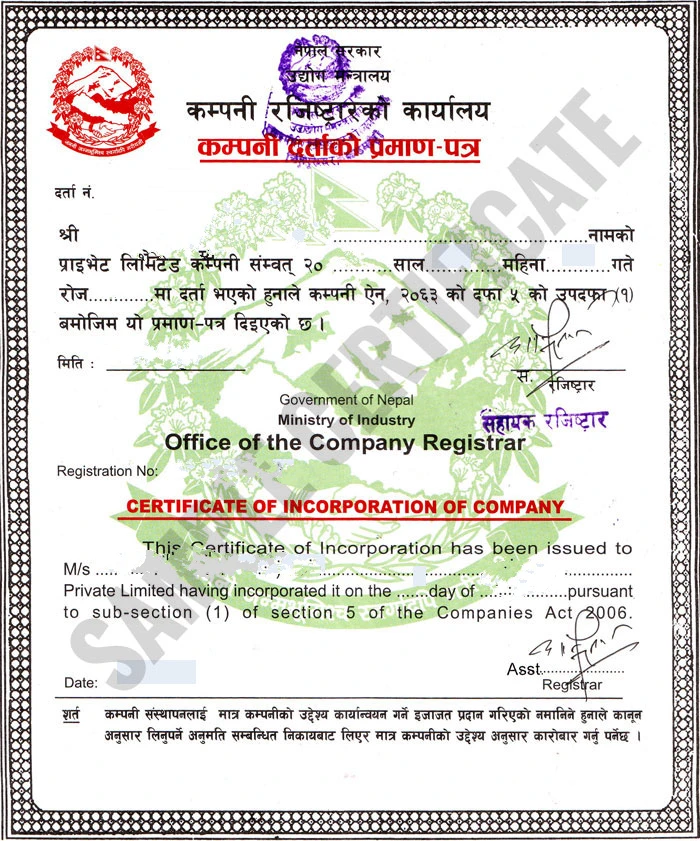
Upon successful verification, the OCR issues the Certificate of Incorporation formally recognizing the company as a legal entity.
Step 5: Tax Registration
The company must register with the Inland Revenue Department (IRD) to obtain a Permanent Account Number (PAN) for tax purposes.
Step 6: Business Registration at Local Government
The company must register with the relevant local government (usually the ward office) for local business operation approval.
4. Timeline
The entire registration process typically takes 7 to 10 working days, assuming all documents are complete and correctly submitted.
5. Required Documents for Private Company Registration
| S.N | Document Required |
|---|---|
| 1. | Application For Registration |
| 2. | Memorandum of Association (MOA) and Article of Association (AoA) |
| 3. | Shareholder Agreement (If applicable) |
| 4. | Citizenship Certificate or passport of individual investors |
| 5. | Certificate of Incorporation and constitutional document of corporate investor |
| 6. | Corporate resolution approving the investment (For Corporate investor) |
| 7. | Foreign Investment Approval Letter (If Applicable) |
6. Key Characteristics of Private Companies
- Number of Shareholders: Minimum 1; maximum 101
- Number of Directors: As specified in the Articles of Association
- Independent Directors: Not mandatory
- Share Transfer: Requires consensus among shareholders
- Public Invitation for Shares/Debentures: Not permitted
- Name Suffix: Must end with “Pvt. Ltd.”
- Company Secretary: Not compulsory
- Approval to Start Business: No need for additional OCR approval post-registration
- Minimum Paid-up Capital: Not fixed by law, but typically at least NPR 100,000
- Business Types: No specific restrictions, except those requiring sectoral approvals
7. Government Fee for Private Company Registration
| S.N | Authorized Capital (NPR) | Registration Fee (NPR) |
|---|---|---|
| 1. | Upto 100,000 | 1,000 |
| 2. | 100,000 – 500,000 | 4,500 |
| 3. | 500,000 – 2,500,000 | 9,500 |
| 4. | 2,500,000 – 10,000,000 | 16,000 |
| 5. | 10,000,000 – 20,000,000 | 19,000 |
| 6. | 20,000,000 – 30,000,000 | 22,000 |
| 7. | 30,000,000 – 40,000,000 | 25,000 |
| 8. | 40,000,000 – 50,000,000 | 28,000 |
| 9. | 50,000,000 – 60,000,000 | 31,000 |
| 10. | 60,000,000 – 70,000,000 | 34,000 |
| 11. | 70,000,000 – 80,000,000 | 37,000 |
| 12. | 80,000,000 – 90,000,000 | 40,000 |
| 13. | 90,000,000 – 100,000,000 | 43,000 |
| 14. | Above 100,000,000 | NPR 30 per Lakh |
8. Additional Fees
| S.N | Particulars | Government Fee |
|---|---|---|
| 1. | Guarantee deposit at DOI (Foreign investment) | NPR 20,000 (Approx USD 155) |
| 2. | Business Registration at ward office (Note: Fees vary by local level) | NPR 5,000 – 15,000 per year (Approx USD 38 – 115) |
| 3. | House Rent Tax | 10% of Monthly rent, often collected 4–6 months in advance |
9. Post-registration Compliance
- Obtain specific sectoral licenses, if required (see below).
- Submit three-month compliance documents to OCR.
- Record foreign investments with Nepal Rastra Bank (NRB), if applicable.
- File annual compliance documents with OCR.
- Comply with Companies Act, Labor Act, Tax Act, and other applicable laws.
10. Sector-specific Approvals
| S.N | Business Type | Licensing Authority |
|---|---|---|
| 1. | Colleges | Affiliated University |
| 2. | Insurance companies | Insurance Board |
| 3. | Banks and Financial Institutions | Nepal Rastra Bank |
| 4. | Hydropower Projects | Electricity Development Board |
| 5. | Travel and Trekking | Ministry of Tourism, Culture and Civil Aviation |
| 6. | Food Industries | Department of Food Technology and Quality Control |
| 7. | Telecommunications | Nepal Telecommunication Authority |